
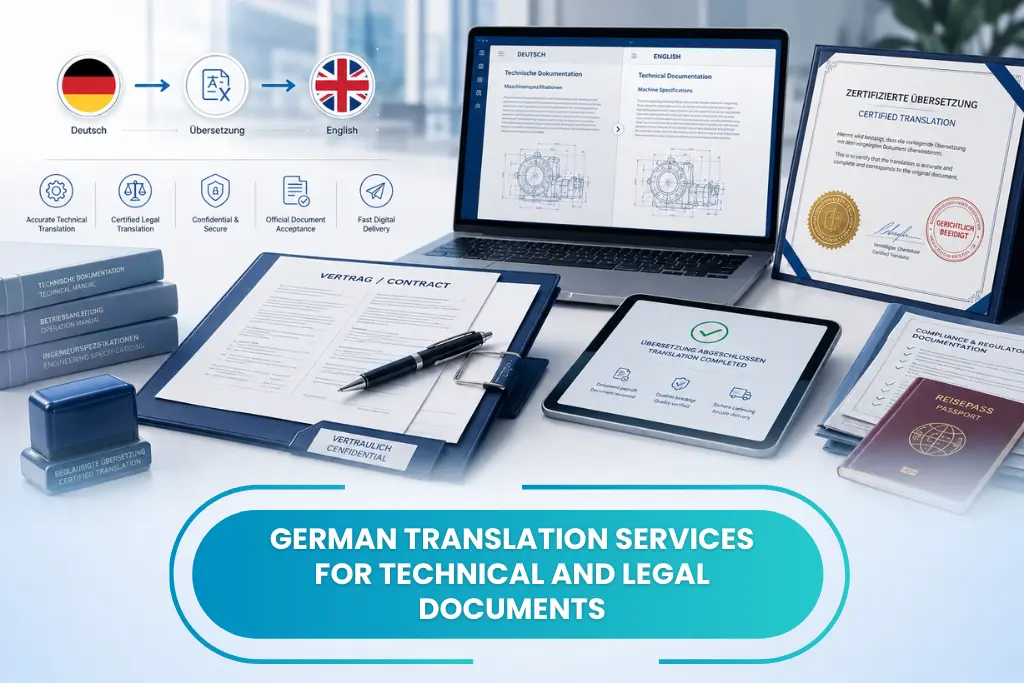
German translation services for technical and legal documents involve converting specialised content — such as contracts, patents, engineering manuals, medical records, regulatory filings, and compliance documents — from German to English or from English into German, with full preservation of meaning, terminology, and legal validity. Businesses and individuals working with Germany, Austria, or Switzerland — collectively representing Europe’s largest economy and one of the world’s most significant trading blocs — require professional translators with subject-matter expertise, not just fluency in the German language. Whether you need a patent specification translated for a filing deadline, a manufacturing manual adapted for German-speaking engineers, or a court document prepared for immigration proceedings, accurate and certified translation is non-negotiable.
Why German Translation Matters for Technical and Legal Documents
Germany is the Federal Republic at the heart of European trade, manufacturing, automotive, pharmaceutical, and financial sectors. Global companies entering or operating in DACH markets (Germany, Austria, Switzerland) regularly need to translate documents across industries where precision carries legal and commercial consequences.
The challenge with technical and legal document translation is that the German language uses long compound words, formal register distinctions, and sector-specific terminology that differ substantially from English. A word-for-word or machine translation approach introduces ambiguity or legal risk. Only a professional translator with proven expertise in the subject area and the target language can ensure translation’s accuracy at the level these documents demand.
Certified german translation services are specifically required when submitting official documents to government agencies, courts, immigration authorities, academic institutions, or corporate bodies in German-speaking countries. Without the right certification, documents may be rejected outright.
Common Documents That Require German Translation Services
Understanding which documents are most frequently involved in translation projects helps businesses plan better. The most common documents requiring german to english or English to German professional translation include:
Legal documents: Contracts, non-disclosure agreements, litigation materials, court orders, powers of attorney, and compliance reports all require legal translation handled by translators with a legal background. Any error in these documents can have binding consequences.
Technical documents: User manuals, product specifications, engineering drawings, software localization files, training materials, and quality assurance documentation for industries such as automotive, mechanical engineering, and life sciences.
Medical and pharmaceutical documents: German medical translation covers clinical trial documentation, patient informed consent forms, medical device manuals, regulatory submissions, and pharmaceutical product literature. This is a highly regulated domain where translation’s accuracy can directly affect patient safety.
Business communication documents: Annual reports, financial statements, board resolutions, marketing materials, website localization content, and corporate governance documents intended for German-speaking stakeholders.
Immigration and personal documents: Birth certificates, marriage certificates, academic transcripts, diplomas, and identity documents — these typically need certified translation accepted by government agencies in Germany or by consulates processing German visas.
What Makes Certified German Translation Services Different
Certified translation refers to a translated document accompanied by a signed statement from a qualified professional translator — or a recognised translation company — attesting that the translation is accurate and complete to the best of their knowledge. Many official documents, immigration petitions, and legal submissions specifically require certified german document translation.
There are three things that separate professional certified translation services from general language help:
Subject-matter expertise: A human translator working on a patent filing must understand patent law and engineering terminology in both languages. Similarly, german medical translation requires fluency in clinical and pharmaceutical vocabulary in both the source and the target language.
Adherence to process: Reputable translation services follow a structured TEP (Translation, Editing, Proofreading) process. This multi-stage translation process ensures quality at every layer before a document is certified and delivered.
Turnaround time and scale: Professional providers can handle large volumes, accommodate tight deadlines, and manage complex translation projects across formats — whether that means a single legal brief or thousands of words of technical documentation spread across multiple file types.
English Translation Services for German-Language Businesses
The demand for english translation services runs in both directions. German companies expanding into English-speaking markets — the United States, the United Kingdom, or Australia — need their contracts, compliance documents, product manuals, and training materials accurately translated into English. Similarly, software localization and website localization for English markets require not just linguistic translation but cultural and contextual adaptation.
International business communication between German-speaking and English-speaking teams depends on reliable document translation at every stage — from initial proposals and term sheets through to final delivery documentation and after-sales support materials. Relying on informal or unverified translations in these contexts introduces commercial and legal risk that professional translation services are specifically designed to eliminate.
Industries with the Highest German Translation Needs
Certain sectors generate the highest demand for professional german translation services in 2026:
Automotive and engineering: Germany’s automotive industry — home to global leaders in vehicle manufacturing — produces technical documentation in large volumes. Manuals, service bulletins, parts catalogues, and software interfaces all require precise translation between German and English, and often into additional languages such as Spanish, Portuguese, or Arabic.
Life sciences and pharmaceutical: Regulatory submissions to the European Medicines Agency (EMA), clinical study reports, and patient-facing documentation all require german medical translation by translators who understand both the scientific content and the compliance requirements of the target market.
Legal and corporate services: Law firms, corporate legal teams, and government agencies handling cross-border matters between Germany and other jurisdictions depend on certified translation services with demonstrable expertise in German civil and commercial law.
IT and software: Software localization for German-speaking markets goes beyond translating interface strings. It involves adapting terminology, date formats, legal disclaimers, and support content so that the product functions naturally in the German language context.
Getting Started with German Translation Services
Whether you need a single certified document translated for an immigration application or ongoing document translation support for your international business operations, working with an experienced professional partner makes a material difference to outcomes.
Lingual Consultancy offers professional German translation services across technical, legal, medical, and business communication domains — supported by a global team of vetted translators and interpreters, a robust quality process, and offices in Berlin for clients working directly with German-speaking markets. To discuss your german translation needs or request a quote, visit https://lingualconsultancy.com/en/
Frequently Asked Questions (FAQs)
1. What is certified German translation and when do I need it?
Certified German translation is a translated document accompanied by a formal declaration from a qualified translator or translation company confirming its accuracy and completeness. You need certified translation when submitting official documents to government agencies, courts, universities, or immigration authorities — for example, when applying for a German visa, registering a company in Germany, or submitting legal evidence in cross-border proceedings. Without certification, these institutions may not accept the translated document.
Lingual Consultancy provides certified German translation services for personal, legal, and corporate documents, issued with the appropriate declaration and suitable for submission to official bodies in Germany and internationally.
2. What types of technical documents are commonly translated from German to English?
Common technical documents translated from German to English include engineering manuals, product datasheets, installation and operating guides, safety data sheets, patents, quality management documentation, and software localization files. Industries like automotive, mechanical engineering, and life sciences regularly commission these translation projects given Germany’s depth of expertise in each sector.
Lingual Consultancy’s technical translation team includes subject-matter specialists across engineering, life sciences, and IT, ensuring that complex German-language technical content is accurately rendered into English without loss of precision or meaning.
3. How does German medical translation differ from general German translation?
German medical translation requires translators who hold both linguistic proficiency in the German language and specialist knowledge of medical, clinical, or pharmaceutical terminology. Documents such as clinical trial protocols, patient information leaflets, medical device instructions for use, and regulatory dossiers contain highly specific language where a mistranslation can carry serious consequences for patient safety or regulatory compliance.
Lingual Consultancy’s medical translation team handles german medical translation for clinical documentation, pharmaceutical submissions, and healthcare content, working to strict quality standards and structured review processes appropriate for regulated industries.
4. Can machine translation handle German legal documents?
Machine translation has improved significantly but remains unsuitable as a standalone solution for legal documents. German legal language uses precise terminology, formal register, and jurisdiction-specific concepts that do not translate directly into English equivalents. An error in a contract, court submission, or compliance document can introduce legal ambiguity or invalidate the translation entirely. Machine translation is best used as a drafting aid in a post-editing workflow, with a qualified human translator reviewing and correcting the output before delivery.
Lingual Consultancy offers machine translation post-editing (MTPE) for high-volume projects where speed is critical, combining the efficiency of automated translation with the accuracy of expert human review — giving clients competitive rates without compromising on quality.
5. What should I look for in a German translation services provider?
Look for a provider with subject-matter expertise in your industry, a structured quality process (TEP — Translation, Editing, Proofreading), the ability to handle your required document formats, and a track record with clients in your sector. Certification credentials, transparent turnaround time commitments, and clear project management processes are also important factors — especially when handling large volumes or time-sensitive legal translation projects. Data confidentiality and secure file handling are essential for sensitive official documents.
Lingual Consultancy is a global language services provider with offices in Berlin, offering German translation services across legal, technical, medical, and business communication domains. With 12+ years of experience, 16,000+ translators and interpreters, and 15,000+ translation projects completed, the team is equipped to support businesses of all sizes with German translation needs — from single certified documents to ongoing large-scale translation projects.
6. How long does it take to get a German translation done professionally?
Turnaround time depends on the volume of content, subject complexity, and whether certification is required. A standard one-to-two page legal or personal document can typically be delivered within 24 to 48 hours. Larger technical or legal documents — such as a multi-chapter engineering manual or a comprehensive regulatory submission — may require several days to a week, depending on review and certification requirements. Rush turnaround is often available for urgent requests.
Lingual Consultancy works with clients to establish realistic turnaround timelines from the outset of each project and has the capacity to scale delivery for large volumes without compromising on accuracy or certification quality.
7. Do I need a different type of translation for immigration documents versus business contracts?
Yes — the requirements differ. Immigration documents such as birth certificates, marriage certificates, academic transcripts, and passports typically require certified translation that meets the specific standards of the receiving authority (e.g., a German consulate, USCIS, or a university admissions office). Business contracts, on the other hand, require legal translation focused on contractual terminology, clause interpretation, and jurisdictional equivalence — areas where the translator must understand both legal systems involved.
Lingual Consultancy handles both categories, with dedicated teams for personal certified document translation and for commercial legal translation, ensuring that each document translated meets the specific requirements of its intended submission context.