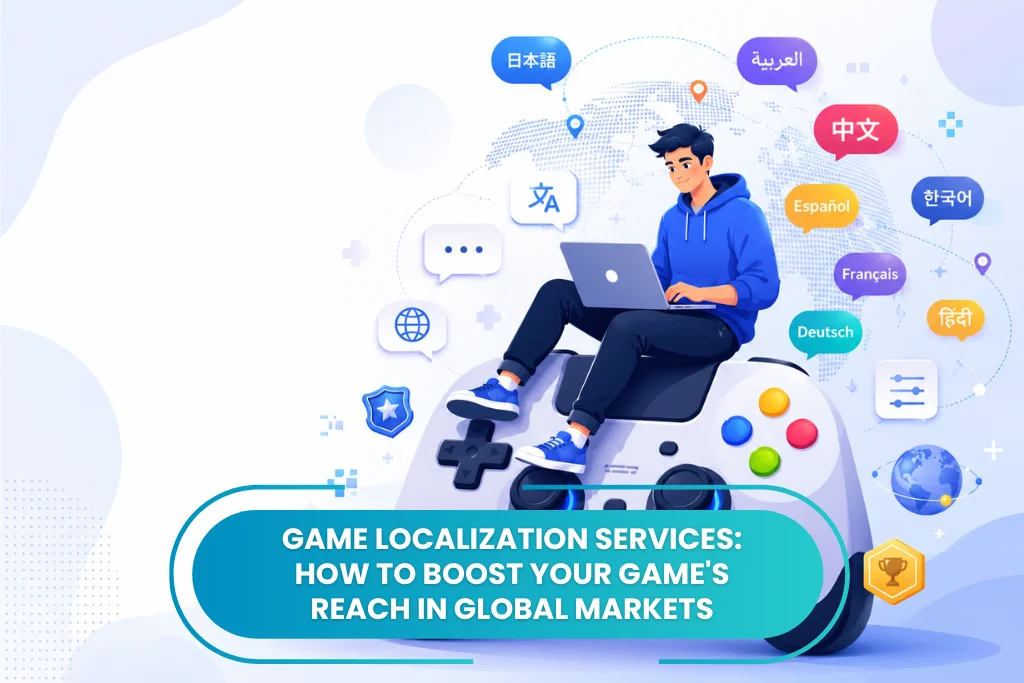
This blog covers everything game developers need to know about game localization services — from what the localization process involves and which language pairs deliver the strongest return, to how to evaluate game localization companies, what separates good translators from specialist gaming linguists, and why titles that invest in professional localization consistently outperform those that do not. Whether you are an indie studio preparing your first international release or an established publisher scaling a AAA title across multiple platforms and markets, this guide explains how video game localization works and what to look for when choosing a localization service that matches your project’s scope, quality standards, and release timeline.
Why Game Localization Services Are Now a Commercial Necessity
The global gaming market has never been more accessible — or more competitive. Players worldwide are spending more time and money on games than ever before, and the vast majority of that audience does not speak English as a first language. Yet so many games still launch in English only, leaving enormous revenue potential untapped simply because the game has not been adapted for the markets where demand already exists.
Game localization is the process of adapting a video game for a specific target market — not just translating the words on screen, but ensuring that every element of the experience, from dialogue and cut scenes to user interface and cultural references, feels native to the player. This is a meaningfully different process from general website localization or document translation. It requires gaming expertise, an understanding of how players engage with localised content, and translators who know the difference between what makes sense linguistically and what makes sense inside the world of a specific game.
The return on investment is well documented. Games that launch with professional localisation in key markets consistently achieve higher download volumes, better review scores, and stronger long-term player retention than those relying on partial or machine-driven translation. For mobile games in particular, where app store visibility is directly tied to localised metadata and in-game content, localization is not a post-launch consideration — it is a core part of the release strategy.
What the Game Localization Process Actually Covers
The localization process for modern games is more complex than most developers expect when they first approach it. A complete game localization project typically spans several interconnected workstreams, each requiring specific expertise and careful coordination.
In-game text covers all dialogue, UI copy, menu text, tutorials, item descriptions, quest objectives, and notifications. For AAA games and narrative-driven titles, this can represent hundreds of thousands of words across multiple file formats — each requiring translation into the target language with full awareness of the in-game context. Translating dialogue without knowing the character speaking it, the tone of the scene, or the choices that preceded it produces localised content that players notice immediately as wrong, even if they cannot articulate exactly why.
Beyond text, most modern games require localisation of dubbing scripts and voice acting. This is one of the most demanding areas of game localisation — it requires not only accurate translation but script adaptation that accounts for timing, mouth sync, emotional register, and the performance notes that guide voice actors in the target language. Voice over recording then needs to be directed and produced to the same standard as the original, with native speakers who understand the character as well as the language.
Cut scenes, subtitles, in-game marketing assets, and platform-specific store listings round out the full scope of a typical localization project. Managing all of this across multiple language pairs simultaneously requires localization companies with established workflows, experienced project managers, and the linguistic assets — glossaries, style guides, translation memory, and character reference documents — to maintain consistency across the entire project.
Language Pairs That Deliver the Strongest Global Reach for Game Developers
Choosing which language pairs to prioritise is one of the first strategic decisions in any game localization project. The answer depends on the game’s genre, platform, target market, and commercial goals — but certain markets consistently deliver strong returns across most game categories.
European languages — German, French, Spanish, and Italian — are the traditional core for Western releases, and they remain high-value markets with well-established gaming communities and strong consumer spending. Brazilian Portuguese is now equally important for any title with Latin America ambitions; the Brazilian gaming market has grown significantly and players there are vocal about their preference for fully localised experiences over English imports.
Japanese is a high-complexity, high-reward market. Japanese players have well-defined expectations around localisation quality, and titles that treat the Japanese version as a second-tier release rarely succeed there regardless of how good the underlying game is. Simplified Chinese and Korean round out the Asian priority markets for most global releases. Together, these language pairs cover the majority of international gaming revenue and represent the realistic first phase for most game developers approaching localisation for the first time.
What to Look for When Evaluating Game Localization Companies
The difference between the best game localization services and general translation companies becomes clear very quickly once a project is underway. General translation companies with no gaming background will struggle with the specific demands of game localisation — the file formats used in game development, the context requirements for in-game strings, the cultural nuances of gaming communities in different markets, and the technical constraints of working within UI character limits.
When evaluating game localization vendors, the most important question is whether they have genuine gaming expertise in your genre. Localising a narrative RPG requires a fundamentally different skill set than localising a competitive multiplayer title or a casual mobile game. Good translators who understand language but have no familiarity with game development, gaming culture, or the specific conventions of a genre will produce technically accurate work that still feels wrong to players.
Look for localization companies that work with native speakers who are themselves gamers, that use established glossaries and linguistic assets for terminology consistency, and that have a clear quality assurance process covering both linguistic accuracy and in-context review — checking how localised strings actually appear and behave inside the game, not just how they read in a spreadsheet. The translation process should include at least one round of in-game review before the localised build is signed off.
For projects involving voice acting and dubbing scripts, the localization service must have audio production capabilities or established relationships with qualified studios in each target language. Separating the text localization from the audio production into different vendor relationships is a common source of quality inconsistency and project delays.
Mobile Games and the Localization Service Requirements That Come With Them
Mobile games present a specific set of localization challenges that differ from console and PC titles. The content volume is often lower, but the turnaround expectations are faster, updates are more frequent, and the app store listing itself is a critical piece of localised content that directly drives downloads.
For mobile games, the localization process needs to be integrated into the development cycle rather than bolted on at the end. Strings should be externalised early, file formats should be agreed with the localization team before content is finalised, and translation memory should be in place from the first update so that recurring content is handled efficiently as the game evolves. Most games that launch into international markets without this infrastructure in place end up with inconsistent localization quality across versions — a problem that compounds with every update.
App store localization — adapting the title, description, and keyword fields for Google Play and Apple App Store in each target language — is often overlooked but has a direct impact on organic discoverability and download conversion. The same keyword research discipline that applies to website localization applies here: what players search for in Japanese, German, or Brazilian Portuguese is not a direct translation of what English-speaking players search for, and store listings should reflect local search behaviour rather than translated English copy.
Lingual Consultancy provides professional game localization services across 100+ languages, combining native-speaking gaming translators, dubbing script adaptation, voice over coordination, and rigorous in-context QA. Contact us to discuss your project.
Frequently Asked Questions (FAQs)
1. What is the difference between game localization and game translation?
Game translation converts text from one language to another. Game localization is a broader process that adapts the entire game experience for a specific target market — including dialogue, user interface, cultural references, cut scenes, dubbing scripts, voice acting, and store listings. Localization ensures the game feels native to players in each market, not just readable. Most games that rely on translation alone without full localization receive noticeably lower review scores in those markets.
Lingual Consultancy provides end-to-end game localization services — not just translation — combining native-speaking gaming linguists, in-context review, and dubbing script adaptation to deliver localised content that holds up to the expectations of players worldwide.
2. Which languages should I prioritise for my game’s first international release?
The strongest first-phase language pairs for most titles are German, French, Spanish, Brazilian Portuguese, Japanese, Simplified Chinese, and Korean. European languages cover high-spending Western markets; Brazilian Portuguese unlocks Latin America; and Japanese, Chinese, and Korean cover the Asia-Pacific region, which accounts for over half of global gaming revenue. The right priority depends on your genre, platform, and the markets where comparable games in your category already have an established audience.
Lingual Consultancy helps game developers identify the right language pairs for their specific title and build a phased localization strategy that maximises return on investment — starting with the markets most likely to respond strongly to your game’s genre and mechanics.
3. How much does game localization cost?
Game localization costs depend on the content volume, number of language pairs, whether voice acting is required, and the complexity of the file formats involved. Text-only localization for a mid-sized mobile game in one language typically costs less than a full AAA localization project spanning multiple languages with dubbed audio. Most localization companies charge on a per-word basis for text, with additional project fees for QA, voice over production, and asset management.
Lingual Consultancy provides transparent project-based quotes for game localization, with pricing tailored to your content volume, language pairs, and timeline. Contact us for a detailed estimate based on your specific project scope.
4. How long does the game localization process take?
A straightforward mobile game with limited text content can be localised into a single language within one to two weeks. A narrative-heavy title or AAA game with extensive dialogue, cut scenes, and voice acting across multiple language pairs may take several months. The localization process runs most efficiently when it is integrated into the development cycle early — late-stage localization, where strings are locked only shortly before release, consistently produces higher error rates and tighter turnarounds that compromise quality.
Lingual Consultancy assigns dedicated project managers to each game localization project, coordinating simultaneous delivery across multiple language pairs to meet release deadlines without sacrificing the in-context review that keeps localised content accurate and consistent.
5. What file formats do game localization companies typically work with?
Game localization vendors work with a wide range of file formats depending on the development platform and engine. Common formats include JSON, XML, CSV, XLIFF, PO files, and engine-specific formats from Unity, Unreal, and other platforms. The localization team needs to be able to handle these formats natively — converting them into intermediate formats for translation and back again without introducing errors. File format handling is one of the clearest indicators of whether a localization service has genuine gaming expertise or is approaching game projects with a general translation workflow.
Lingual Consultancy’s game localization team works natively with all major game development file formats, supporting clean extraction, translation, and reintegration of localised strings across Unity, Unreal, and custom engine projects without disrupting the development pipeline.
6. Do I need separate localization for Spanish in Spain and Latin America?
Yes, for any title that takes its Spanish-speaking audience seriously. Spanish for Spain and Spanish for Latin America differ in vocabulary, tone, cultural references, and the voice acting style that feels natural to each audience. Players in both markets notice a version that was not made for them, and it affects both review scores and long-term retention. Most games with significant Spanish-language audiences produce separate localised versions for each region rather than a single compromise version.
Lingual Consultancy produces dedicated Spanish localisations for both Spain and Latin America, with region-specific native translators and cultural adaptation for each market — ensuring your game feels genuinely native on both sides of the Atlantic.
7. What makes a game localization company genuinely good at their work?
The best game localization services combine native-speaking translators who are themselves gamers, robust linguistic assets including glossaries and style guides, a clear in-context QA process, and experienced project management. General translation companies without gaming expertise will produce technically accurate work that still misses the cultural and contextual nuances that matter to players. The localization process should always include review of localised strings inside the actual game environment, not just in a translation file — errors that are invisible in a spreadsheet become obvious the moment a player encounters them in context.
Lingual Consultancy brings specialist gaming expertise to every project — from indie mobile games to large-scale AAA titles — with native-speaking translators who understand gaming culture in each target market, and a quality assurance process that includes in-context review before every localised build is signed off.