
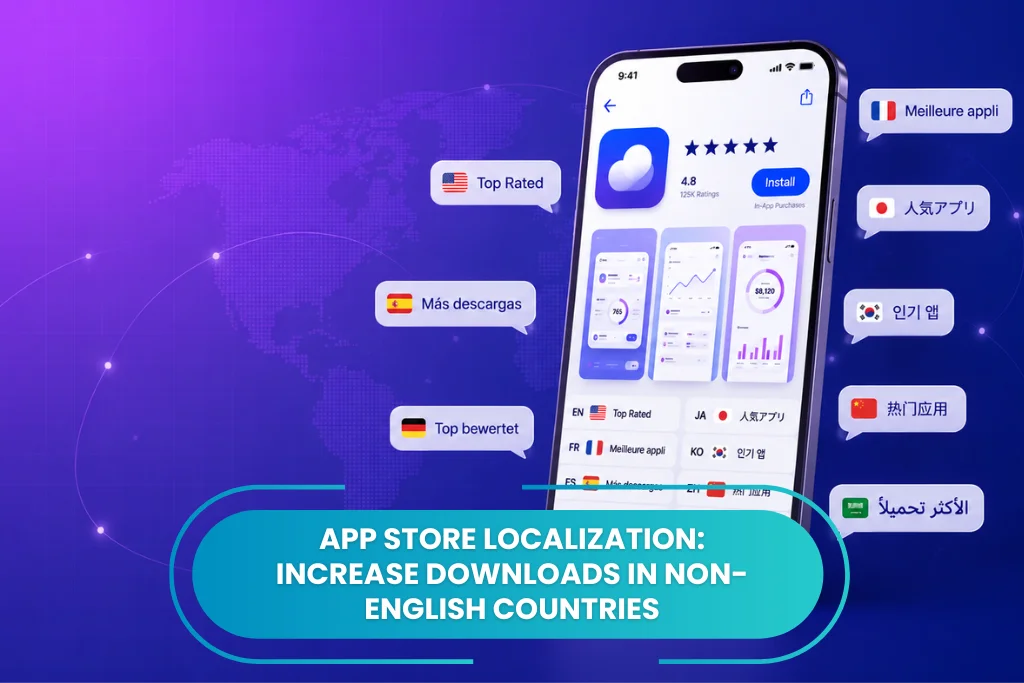
This blog explains how app store localization works and why it is one of the most effective strategies for increasing app downloads in non-English-speaking markets. It covers everything from translating app store metadata and localising the app’s user interface to managing app strings, adapting content for different target markets, and avoiding the common mistakes that cause localization efforts to fail. Whether you are launching iOS and Android apps into new regions for the first time or scaling an existing global audience, this guide walks you through the entire process — and explains when working with professional language service providers delivers results that no machine translation or app localization tool can match.
Why App Store Localization Matters for Global Growth
Most mobile apps launch in only one language and wonder why they struggle to gain traction beyond their home market. The reality is straightforward: if your app store listing and in-app content are not in a user’s local language, the overwhelming majority of those users will not download it — no matter how good the product is.
App store localization is not simply translating text. It is a deliberate strategy that adapts every element of how your app is presented and experienced in each target market — from the app store listing and screenshots to the app’s user interface, date formats, currency format, and plural forms. When done properly, localised apps consistently outperform their English-only counterparts in non-English markets, achieving higher conversion rates, better search rankings, and significantly more app downloads.
The global market for mobile apps is enormous, and the majority of it speaks something other than English. Reaching that user base requires treating localization not as an afterthought but as a core part of the development process.
What Mobile App Localization Actually Involves
Mobile app localization covers two distinct layers that must be handled together for the localization process to succeed. The first is app store localization — adapting the listing itself. The second is in-app localization — adapting the experience once users have downloaded and opened the app.
App store metadata — the title, subtitle, short description, full description, and keyword fields — must be adapted for each locale, not just translated word for word. Users in Japan, Germany, and Brazil search for apps using completely different terms, phrases, and search behaviours. Translating your English metadata directly using Google Translate and submitting it will not deliver meaningful results. Effective app store optimization in non-English markets requires genuine keyword research in each local language, carried out by people who understand how those users actually search.
On the in-app side, localization covers all app strings — every piece of text that appears within the app’s user interface. This includes UI elements such as buttons, labels, menus, error messages, notifications, onboarding text, and help content. It also includes adapting the app UI for languages that read right to left, managing text expansion for languages where translated strings are significantly longer than the English originals, and handling plural forms that differ between languages. Resource files and localized strings must be extracted carefully from code repositories to avoid creating errors in the development process.
App Store Optimization for New Markets: Getting Found Before You Get Downloaded
App store optimization is the foundation of discoverability in any new market. Without it, even a perfectly localised app will remain invisible to the users it is designed for. Each app store — Apple App Store and Google Play — indexes app content differently, which means your localization team needs to understand the specific rules of each platform before adapting your app store listings.
Keyword research for new markets cannot be skipped or shortcut. The keywords that drive downloads in the US market will rarely be the direct translations of the keywords that drive downloads in Spanish, Korean, or Arabic markets. Users in different target markets search using local slang, culturally specific terminology, and phrasing that reflects their own preferences. Only native-speaking linguists with knowledge of local search behaviour can identify these terms reliably.
Screenshots and preview videos are equally important and are consistently underestimated. Keeping English-language screenshots in a localised listing undermines conversion in markets with lower English proficiency. Localising the app content visible in screenshots — and adapting imagery to reflect cultural differences where relevant — has a measurable impact on download rates. Every element of the app store listing should be treated as app content that requires professional adaptation, not just translation.
How to Manage App Strings and Avoid Creating Localization Errors
Managing app strings across multiple languages is one of the most technically demanding parts of the localization process. Each string needs to be extracted from the codebase, translated with sufficient context, reviewed for accuracy, and reintegrated without breaking the app’s user interface. For iOS and Android apps, the workflows differ: iOS uses .strings and .stringsdict files, while Android Studio works with XML resource files. Both require careful handling to avoid creating display errors, truncated text, or missing translations in production.
Context is the most underestimated element of quality in app localization. A single word like ‘Save’ means something completely different in a document editor than it does on a payment screen. Without context, translators make assumptions — and those assumptions produce translation errors that users notice immediately. Professional localization teams use screenshots, glossaries, and in-context review to ensure every localised string functions correctly in the app UI before release.
Continuous localization — integrating translation workflows directly with code repositories so that new and updated strings are handled automatically as the app evolves — significantly reduces manual work and prevents the common problem of untranslated strings appearing in production. Leveraging translation memory across updates also maintains brand voice and translation quality consistently across all languages over time, while reducing costs as the app scales into more markets.
Machine Translation and When It Falls Short for App Localization
Machine translation has a clear role in app localization — it can accelerate the process for high-volume string updates, provide rough drafts for human review, and reduce costs for lower-priority content. However, relying on machine translation alone for app store listings, in-app UI elements, and user-facing content produces results that fall short of the translation quality professional markets expect.
Google Translate and similar tools are widely used for quick, internal-facing translations where errors carry limited consequences. For consumer-facing app content — particularly app store listings, where translation quality directly affects download conversion rates — the limitations of machine translation become commercially significant. Localised strings produced without human review frequently contain unnatural phrasing, incorrect terminology, and cultural tone that feels foreign to local users. In markets where competitors have invested in professional mobile app localization, a machine-translated listing signals low quality before a user has even opened the app.
The most effective approach for apps targeting multiple languages combines automated workflows for high-volume, lower-stakes content with professional human translation for app store metadata, core UI elements, and any content that directly shapes the user’s first impression. Pre-production QA — reviewing localised content in context before release — is non-negotiable for catching errors that only become visible when translated strings are rendered in the actual app UI.
Which Markets to Prioritise for App Localization First
Not every market requires the same level of localization investment. A practical approach to reaching a global audience is to prioritise markets by a combination of download potential, revenue opportunity, and localization complexity.
The highest-priority markets for most English-language apps are those with large, engaged mobile user bases and strong consumer spending — markets where the return on localization investment is fastest. These typically include Spanish-speaking markets (both Latin America and Spain), German, French, Japanese, Korean, Portuguese (Brazil), Simplified Chinese, and Arabic. Each of these markets has distinct cultural differences, search behaviours, and content expectations that require genuine localization rather than direct translation.
A phased approach — launching in two or three priority markets first, measuring the impact on app downloads and higher revenue per user, then expanding to additional new regions — allows localization efforts to be validated and refined before scaling. This approach also allows automated workflows and translation memory built during the first phase to be reused efficiently as the app supports more languages.
Lingual Consultancy provides professional app store localization and mobile app localization services across 100+ languages, combining native-speaking linguists, ASO expertise, and rigorous quality assurance. Contact us to discuss your international launch.
Frequently Asked Questions (FAQs)
1. What is the difference between app translation and app store localization?
App translation converts text from one language to another. App store localization is a broader process that adapts the entire app store listing — including metadata, keywords, screenshots, and preview videos — for each target market. Localization also accounts for cultural differences, local search behaviour, currency format, date formats, and the specific requirements of the Apple App Store and Google Play in each region.
Lingual Consultancy provides end-to-end app store localization services that go beyond translation — combining native-speaking linguists, local keyword research, and ASO expertise to ensure your app listing converts in every market you enter.
2. Can I use Google Translate or machine translation for my app store listing?
Machine translation can serve as a starting draft for internal or lower-priority content, but it is not reliable enough for app store listings or core UI elements without thorough human review. Translation quality directly affects download conversion rates — and in competitive markets, a machine-translated listing signals low quality to users who expect apps to feel native to their local language.
Lingual Consultancy uses professional human translators with app localization expertise for all consumer-facing content, with machine translation reserved for high-volume, lower-stakes strings where automated workflows add genuine efficiency without compromising quality.
3. How many languages should I localise my app into first?
Start with two to three high-priority markets where your app has the clearest revenue potential and the localization investment is most likely to return measurable growth in app downloads. Spanish, German, Japanese, and Brazilian Portuguese are consistently strong first choices for English-language apps. A phased approach allows you to validate results before expanding into additional new markets.
Lingual Consultancy helps clients prioritise target markets based on their specific app category, user base, and commercial goals — then builds scalable localization workflows using translation memory so that each additional language becomes progressively faster and more cost-effective.
4. What are app strings and why do they matter for localization?
App strings are every piece of text that appears within the app’s user interface — buttons, labels, error messages, notifications, onboarding copy, and help content. Managing app strings correctly is critical because each string needs to be translated with sufficient context to produce accurate results. Without context, translators make assumptions that produce errors visible to users in the live app. Plural forms, text expansion, and right-to-left language support add further complexity that requires careful handling.
Lingual Consultancy manages the full app strings localization process — from extraction and contextual translation through to quality assurance and reintegration — ensuring every localised string functions correctly in the app UI before your update goes live.
5. How does app store localization improve app store optimization?
App store optimization in non-English markets depends on localised keywords that reflect how users in each region actually search — not direct translations of English terms. Localised app store metadata, including the title, subtitle, description, and keyword fields, signals relevance to the App Store and Google Play algorithms in each locale, improving search rankings and organic discoverability. Localised screenshots and preview content improve conversion rates once users reach the listing.
Lingual Consultancy combines professional translation with local keyword research for each target market, ensuring your app store listings are optimised for both search visibility and download conversion in every language you launch in.
6. How long does the app store localization process take?
A single-language app store listing localization — covering metadata, screenshots copy, and core UI strings — can typically be completed within three to five business days. Full in-app localization for a complex app with extensive app strings and multiple languages may take two to four weeks, depending on volume and the number of target languages. Continuous localization workflows that integrate with code repositories significantly reduce turnaround times for ongoing updates.
Lingual Consultancy offers both standard and expedited timelines for app localization projects, with dedicated project managers coordinating delivery across multiple languages simultaneously to meet your launch deadlines.
7. What is continuous localization and does my app need it?
Continuous localization integrates translation workflows directly with your development process so that new and updated app strings are handled automatically as the app evolves, rather than in large, infrequent batches. It reduces manual work, prevents untranslated strings appearing in production, and keeps all languages current with every app update. Apps that update frequently — adding features, fixing UI copy, refreshing onboarding — benefit significantly from continuous localization.
Lingual Consultancy sets up and manages continuous localization workflows for mobile app clients, connecting translation pipelines with code repositories and leveraging translation memory to maintain consistency and reduce costs across all supported languages as your app scales into new markets.

