
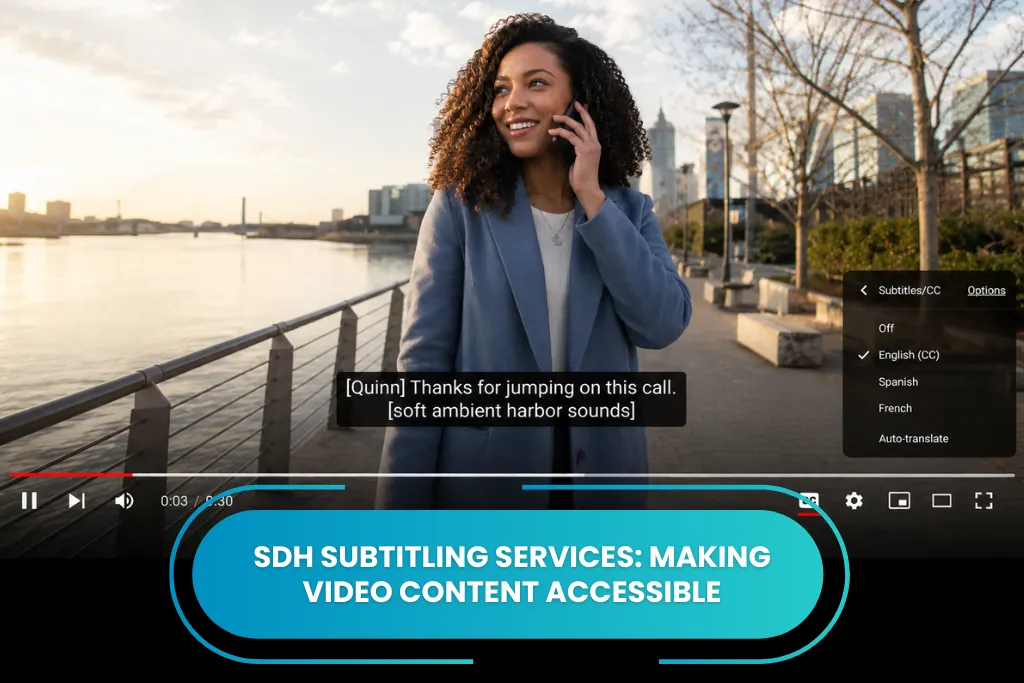
SDH subtitling — or Subtitles for the Deaf and Hard of Hearing — is a specialised form of closed captioning that goes beyond transcribing spoken dialogue. It captures background noise, sound effects, music cues, speaker identification, and other audio elements on screen, ensuring that deaf and hard of hearing audiences receive the full communicative experience of any video content. Unlike traditional subtitles that assume viewers can hear the audio and only need translated dialogue in a foreign language, SDH subtitles are designed to make every layer of a video’s audio accessible — from a character’s whispered line to a thunderclap off screen.
Closed Captions and SDH: Understanding the Key Differences
Many producers and broadcasters use the terms closed captions and SDH interchangeably, but there are important key differences between the two formats that affect how content is delivered across streaming platforms, public broadcasts, and digital video channels.
Closed captioning is an older broadcast standard developed primarily for television. Closed captions are encoded as control codes within the video signal, technically invisible until activated by the viewer. They typically appear as white text on a black background or as usually white text with a black outline, and the viewer can turn them on or off — hence “closed.” Support closed captions is mandatory under broadcasting regulations in many countries.
SDH subtitles, by contrast, are commonly used on digital video, Blu-ray, and streaming content. They are rendered as on screen text — often as bitmap images or a styled text overlay — and are formatted for hearing viewers who may be watching in a foreign language environment, as well as for the deaf and hard of hearing. SDH includes speaker labels (also called speaker tags or speaker ids), descriptions of background noise, loud noises, and other audio elements that standard subtitles omit.
The biggest benefit of SDH over traditional subtitles is comprehensiveness: where standard subtitles assume the viewer can hear everything except the spoken dialogue, SDH subtitles treat audio information as something that must be fully conveyed in text.
Why Hard of Hearing SDH Access Matters for Your Audience
Over 1.5 billion people worldwide live with some degree of hearing impairments, and that number continues to grow. For any organisation producing video content — whether corporate videos, streaming content, e-learning, or public broadcasts — failing to provide accessibility services for deaf or hard of hearing viewers is both a missed opportunity and, in many jurisdictions, a legal liability.
Hard of hearing viewers don’t just struggle with dialogue. Background noise, music, and off screen sounds carry narrative weight. A viewer with trouble understanding audio needs to know not just what was said, but that an alarm was ringing, that music indicated a tense moment, or that the speaker was on a phone call — all context that hearing audiences absorb automatically.
English SDH subtitles for English-language content, or translated dialogue with full audio descriptions for foreign language content, ensure that your media content is truly inclusive.
Accessibility Guidelines and Standards: What You Need to Know
Compliance with accessibility standards is a growing requirement across industries. Regulations such as the Americans with Disabilities Act (ADA), the UK Equality Act, and the EU Web Accessibility Directive all include provisions around captioning and accessible media. Streaming services operating in multiple markets must meet varying national accessibility goals to remain compliant.
Key accessibility guidelines for SDH and closed captioning typically require:
Accurate transcription of all spoken dialogue
Speaker identification using speaker names or speaker tags where multiple voices are present
Description of relevant sound effects, music, and other audio elements
Proper synchronisation with the source language audio
Readable formatting — sufficient contrast, readable font size, and appropriate display duration
Failure to meet these industry standards can result in regulatory penalties, exclusion from key streaming platforms, and reputational damage — particularly for organisations with public-facing media files.
What Good SDH Subtitling Looks Like in Practice
A professional SDH subtitler does much more than transcribe spoken dialogue. Here is what distinguishes quality SDH from a basic caption:
Speaker identification: Each speaker is identified through speaker names or bracketed speaker labels — e.g., [INTERVIEWER]: — so that deaf and hard of hearing viewers always know who is speaking, especially in multi-speaker content.
Sound effects and background noise: Descriptive tags such as [DOOR SLAMS], [CROWD CHEERING], or [SOFT MUSIC PLAYING] replace the audio information that hearing audiences take for granted.
Music cues: When music carries emotional or narrative significance, SDH includes descriptions such as [TENSE ORCHESTRAL MUSIC] or [UPBEAT THEME PLAYS].
Off screen audio: Sounds originating off screen — a ringing phone, a voice on a television, distant thunder — are clearly flagged so viewers understand the context.
Formatting for readability: Quality SDH uses clean on screen text, adequate contrast (typically white text with a black outline or on a black background), and sensible line breaks to avoid cognitive overload.
SDH Subtitling for Streaming Platforms and Global Distribution
The growth of streaming services has placed accessibility front and centre. Netflix, Amazon Prime, Disney+, and other major platforms require SDH tracks for content distributed in markets with legal accessibility obligations. Content without SDH is frequently rejected during platform QC (quality control) reviews.
For content distributed in multiple languages, SDH subtitling also intersects with translation. Translated dialogue must carry the same layer of accessibility — speaker identification, sound effects descriptions, and other audio elements — in the target language. This is distinct from simply adding closed captions and SDH subtitles in the same language as the audio; multilingual SDH requires linguists who understand both the source language context and the target audience’s accessibility needs.
Corporate videos intended for global employee audiences, training modules deployed across different languages, and e-learning content published to select programming platforms all benefit from SDH tracks that meet international accessibility standards.
Partner with Lingual Consultancy for Professional SDH Subtitling Services
Making video content fully accessible to deaf and hard of hearing audiences requires more than inserting text on screen. It demands expert knowledge of accessibility guidelines, platform requirements, speaker identification conventions, and the nuanced craft of conveying audio information in written form.
Lingual Consultancy is a globally connected language services provider with offices in India, Germany, the United States, France, and Myanmar. With a network of over 16,000 linguists and subtitlers, Lingual Consultancy delivers SDH subtitling and closed captioning services across multiple languages — for streaming platforms, corporate videos, broadcast content, e-learning, and more. Every project is handled by experienced professionals who understand both the technical standards and the human importance of genuine accessibility.
Whether you need English SDH subtitles for a domestic streaming release, multilingual SDH for global distribution, or closed captioning for public broadcasts, Lingual Consultancy has the expertise and capacity to deliver — accurately, on time, and to the accessibility standards your audience deserves.
Get in touch with Lingual Consultancy today to discuss your SDH subtitling requirements.
Frequently Asked Questions (FAQs)
1. What is the difference between SDH subtitles and closed captions?
Closed captions are encoded as hidden control codes in a broadcast signal and can be toggled on or off by the viewer — hence the term “closed.” They are common in public broadcasts and traditional television. SDH subtitles are a format used in digital video and streaming, presenting on screen text that includes speaker identification, sound effects, and background noise descriptions in addition to spoken dialogue. While both serve deaf and hard of hearing audiences, SDH is optimised for digital distribution and typically carries more detailed audio information.
For professional SDH and closed captioning tailored to your distribution platform, Lingual Consultancy provides accurate, platform-compliant accessibility services across multiple languages.
2. Are subtitles and closed captions the same thing?
No — and the distinction matters for accessibility. Standard subtitles assume the viewer can hear the audio; they typically carry only translated dialogue for foreign language audiences. Closed captions and SDH are designed for viewers with hearing impairments and include descriptions of sound effects, music, and other audio elements that convey meaning beyond spoken words. Subtitles assume hearing; SDH subtitles do not.
Lingual Consultancy offers both standard subtitling and full SDH captioning depending on your content and audience requirements — correctly matched to your platform’s technical specifications.
3. Do streaming platforms require SDH subtitles?
Yes. Most major streaming platforms have mandatory accessibility requirements for content published on their services. Netflix, for example, requires timed text files meeting specific SDH formatting standards, including speaker identification and sound effect descriptions. Submitting content without compliant SDH tracks often results in QC rejection and delays in content going live.
Lingual Consultancy works with producers and distributors to deliver streaming-ready SDH files in the correct format — whether SRT, TTML, WebVTT, or platform-specific variants — ensuring your content meets accessibility goals without delays.
4. Can SDH subtitles be provided in multiple languages?
Yes. SDH subtitling is not limited to the source language. When content is distributed internationally, SDH tracks must be created for each target language — with translated dialogue, localised speaker tags, and culturally appropriate descriptions of audio elements. This is particularly important for corporate videos, e-learning modules, and streaming content reaching diverse global audiences.
Lingual Consultancy supports SDH subtitling in multiple languages through its network of over 16,000 linguists, combining translation expertise with accessibility knowledge to deliver SDH that serves deaf and hard of hearing viewers in any language.
5. What makes SDH subtitling different from automated captioning?
Automated captioning transcribes speech but consistently misses non-speech audio — background noise, music cues, off screen sounds, and speaker identification — that are essential for deaf and hard of hearing viewers. Automated output also struggles with accents, overlapping speakers, technical terminology, and proper nouns, producing captions that may be inaccurate or misleading. Accessibility standards require accurate, human-reviewed SDH for compliance-grade content.
Lingual Consultancy’s SDH services are delivered by trained human subtitlers who apply accessibility guidelines rigorously — producing captions that genuinely serve hearing impairment communities, not just pass a surface-level check.
6. What formats are used for SDH and closed captions in digital video?
SDH and closed captions for digital video can be delivered in several formats depending on the platform and use case. Common formats include SRT (SubRip Text), WebVTT (Web Video Text Tracks), TTML/DFXP (used widely in streaming), and SCC (for broadcast-style closed captions). Bitmap image-based subtitles — such as those embedded in Blu-ray discs — are also used for SDH where styled text rendering needs to be locked. Each platform specifies which format it accepts, and submitting the wrong format can cause display errors even when the caption content is correct.
Lingual Consultancy handles format conversion and technical delivery, ensuring your SDH files are correctly structured for every platform — from streaming services to broadcast and digital connections.
7. Who needs SDH subtitling beyond traditional deaf audiences?
SDH subtitling benefits a broader audience than most content owners realise. Beyond viewers who are deaf or hard of hearing, SDH helps: non-native speakers watching content in a foreign language; viewers watching in sound-sensitive environments (offices, public transport, shared spaces); elderly viewers who may have difficulty understanding audio; and anyone watching content with poor audio production or heavy background noise. Research consistently shows that captions increase viewer engagement and content retention across all audience segments.
Lingual Consultancy’s SDH and closed captioning services make your video content accessible to every viewer — expanding your audience reach while meeting your legal and platform accessibility obligations.

