
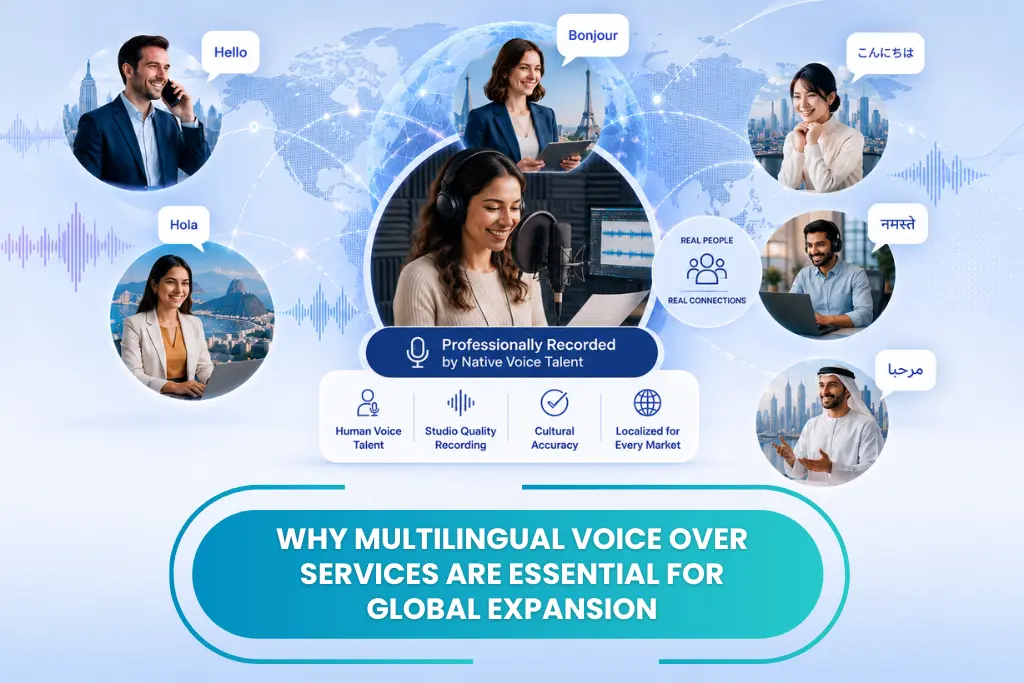
Multilingual voice over services are professional audio productions in which trained voice actors record scripts in multiple languages, delivering culturally adapted narration, character performances, or commercial messaging that resonates with audiences in their native tongue. This blog is for business owners, marketing managers, L&D teams, and content producers who want to expand into new international markets and need to understand why investing in professional voice over talent — not automated substitutes — is one of the highest-impact decisions they can make in 2026. Whether you are localizing an e-learning course, launching a product commercial in Southeast Asia, or rolling out corporate training across Europe, professional multilingual voice overs ensure that your message doesn’t just translate — it connects.
What Are Multilingual Voice Over Services and Who Needs Them?
Multilingual voice over services involve recording spoken audio content in two or more languages, with each version delivered by voice actors who are native or highly proficient speakers of the target language. The process goes beyond word-for-word translation. It accounts for tone, character, regional accent, pacing, and cultural nuance — all the elements that make audio feel natural to the listener.
Businesses that benefit most include those in e-learning and corporate training, media and entertainment, advertising and commercials, healthcare communications, and software products. If your audience spans more than one country and your content relies on the spoken word — whether in video, radio, narration, or interactive platforms — you need multilingual voice overs.
Why Human Voices Still Matter More Than Ever in 2026
The voice over industry has seen significant automation in recent years, and AI voices have become more widely available. However, for professional production work, clients continue to return to human voices — and for good reason.
A professional actor brings something no synthetic voice can replicate: intent. Human voice acting involves micro-decisions about timing, breath, emotional weight, and character that accumulate into a performance. When listeners hear genuine human voices in a brand’s content, they respond differently — with more trust, more retention, and greater emotional engagement. Research across industries consistently shows that learners retain more from e-learning content narrated by a human voice, and consumers respond more favourably to commercials featuring authentic human performance rather than AI-generated audio.
The quality control standard for professional voice overs also demands human involvement. A good voice over talent doesn’t just record — they interpret a script, adapt to project requirements, and take direction from producers. This feedback loop simply doesn’t exist with automated systems. For businesses expanding globally, the ability to hire a voice over talent who understands the cultural context of a script is not a luxury — it is a professional necessity.
The Business Case for Multilingual Voice Over in Global Expansion
When brands enter new international markets, localization is the bridge between a foreign product and a local audience. Multilingual voice over services are a core pillar of that bridge.
Consider e-learning: organisations deploying training programmes across multiple regions cannot afford to have learners disengage because narration sounds robotic or unnaturally paced. A professionally voiced module delivered in French, Mandarin, Arabic, or Portuguese — each by a native speaker with the right tone and professional delivery — dramatically improves course completion rates and knowledge retention.
In advertising and commercials, the same principle applies. A script written for a UK audience requires a different voice, rhythm, and cultural register when adapted for Brazil or Japan. Hiring professional voice actors who understand these nuances ensures the campaign lands as intended — not as a translation exercise that lost the plot.
Corporate communications present a similar case. Global teams receiving training videos, company announcements, or compliance content feel more respected and engaged when spoken to in their own language by a voice that sounds natural and credible. The perception of quality extends directly to the perception of the brand.
Key Industries Driving Demand for Professional Voice Over Talent
E-learning and Corporate Training
The global e-learning market continues to expand rapidly, with organisations across every sector deploying multilingual content for compliance training, onboarding, skills development, and certification. E-learning voice overs require a specific skill set — clear diction, measured pacing, and the ability to make dense informational content engaging. This is professional voice work that demands experience, not a quick automated pass.
Advertising and Commercials
From radio spots to digital pre-roll ads, commercials depend on the voice to carry the brand personality. Whether the brief calls for an authoritative tone, a warm conversational style, or an energetic call to action, professional voice actors deliver performances calibrated to the brand’s needs across multiple languages and markets.
Corporate Narration and Voice Overs for Business
Product explainers, investor relations videos, documentary narration, and brand films all benefit from voice over talent who can handle long-form voice work with consistency and professionalism. Corporate voice overs require performance stamina and technical delivery that goes beyond what a home recording setup typically achieves.
Entertainment and Character Voice Acting
Animation, video games, audiobooks, and digital media require character-based voice acting that conveys personality and emotion. Voice acting at this level is a distinct craft, and finding the right talent across multiple languages requires access to a broad, vetted roster. The performance demands — from comedic timing to dramatic delivery — are what separate professional voice actors from casual narrators.
What to Look for When Finding Professional Voice Over Talent and the Right Partner
Not all voice over providers are equal. Here are the key factors that distinguish a professional multilingual voice over service from a basic talent marketplace:
Native-speaker talent across languages. The voice actors should be native or near-native speakers of the target language, with regional accent options where required. A Spanish voice over for a Mexican audience sounds different from one for an Argentinian or Spanish audience — and it matters. A few popular platforms have popularised the idea of open self-service casting, but for multilingual projects with strict quality requirements, a managed agency approach gives brands far more control over who they cast and how performances are directed.
Rigorous quality control. A professional service includes audio engineering, direction, review, and approval stages before delivery. Quality control is not optional — it is what separates studio-grade output from a rough recording.
The perfect voice matched to brief. The ability to match the right voice talent to a specific brief — warm, authoritative, energetic, instructional — is a curation skill. Finding the perfect voice for a brand project requires understanding both the performance requirements and the audience. A professional agency pre-screens talent and recommends options based on your project requirements.
Scalability across languages. If you are localizing content into ten languages simultaneously, you need a partner with the infrastructure to manage casting, recording, quality review, and delivery at scale. Voice actors who want to find work at this level typically connect through established agencies rather than marketplace platforms, because agency-managed projects offer consistent direction, fair pay, and repeat engagement.
Studio quality from end to end. Whether recorded in professional studios or certified home studios, the audio must meet broadcast-quality standards. Clean recording environments, proper equipment, and technical oversight are non-negotiable for professional production.
How Lingual Consultancy Delivers Multilingual Voice Over Services
Lingual Consultancy provides professional multilingual voice over services to businesses expanding into global markets. With access to a roster of experienced professional voice actors across 100+ languages, and a rigorous quality control process built on over 16,000 vetted language professionals, Lingual Consultancy manages voice over projects from script to final audio delivery.
Whether the need is e-learning narration, commercial voice over, corporate communication, or entertainment content, the team works to match the right voice talent to each project — by language, accent, tone, and character. Clients can request custom demos before committing, ensuring the voice fits the brief before production begins. Projects are managed end-to-end, with technical quality review at every stage.
For businesses ready to scale their content globally without compromising on quality, Lingual Consultancy offers the professional infrastructure to do it right. Contact Lingual Consultancy to discuss your multilingual voice over project and receive a customised quote.
Frequently Asked Questions (FAQs)
1. What exactly are multilingual voice over services, and how do they work?
Multilingual voice over services involve recording spoken audio content in multiple target languages, delivered by professional voice actors who are native or highly proficient speakers. The process includes script translation, talent selection, studio recording, audio engineering, and quality review. For each language version, a separate voice actor records the adapted script to ensure the delivery sounds natural and culturally appropriate — not like a translation read aloud.
Lingual Consultancy provides end-to-end multilingual voice over services across 100+ languages, managing everything from talent casting to final delivery so clients receive broadcast-ready audio without managing the process themselves.
2. Why should I choose human voice actors over AI voices for my project?
Human voice actors bring performance, intent, and cultural nuance that automated voices consistently lack. Professional voice acting involves tonal interpretation, emotional layering, and the ability to take direction — qualities that matter enormously in e-learning, advertising, and corporate content where audience engagement and brand credibility are at stake. Listeners also perceive human voices as more trustworthy and retain more information from professionally performed narration.
At Lingual Consultancy, all voice over projects are performed by vetted professional actors — no AI voices substituted without client knowledge. For businesses where brand reputation and audience impact matter, human voice work is the standard.
3. How do I find the right voice over talent for my language and project type?
Finding the right talent means matching multiple variables: the target language and regional accent, the tone and character the brand requires, the technical demands of the format (e-learning, commercial, narration), and the budget. Reputable agencies pre-screen talent, maintain diverse rosters, and provide custom demos so clients can listen before committing to a voice.
Lingual Consultancy handles talent matching as part of its voice over service — presenting clients with shortlisted options that fit the brief, rather than leaving them to navigate open platforms and manage auditions independently.
4. What languages are available for professional multilingual voice overs?
The range of available languages depends on the provider’s talent network. Major commercial languages — Spanish, French, German, Mandarin, Arabic, Japanese, Portuguese — are widely available. Less common languages require providers with deep networks and the ability to source and vet talent beyond the major markets.
Lingual Consultancy offers professional voice over services across 100+ languages, including regional variants, with access to native-speaker talent across both widely spoken and less common languages — making it a suitable partner for complex multilingual rollouts.
5. How are voice over projects priced, and what affects the budget?
Voice over pricing is typically influenced by word count or script length, the number of languages required, the level of production involved (studio recording vs. home studio), usage rights (broadcast, online, internal), and turnaround time. Talent rates also vary by language, experience level, and the type of project — commercial work generally commands a higher rate than internal narration.
Lingual Consultancy provides transparent project-based quotes based on your specific script, language requirements, and usage scope — so clients can plan budgets accurately before work begins.
6. Is professional voice over worth the investment for e-learning content?
Yes — for several proven reasons. E-learning course completion rates are directly influenced by audio quality and narration performance. Learners disengage from courses with robotic or poorly paced narration, reducing both completion and retention. A professionally voiced module in the learner’s native language signals respect and improves the overall learning experience.
Lingual Consultancy specialises in e-learning voice over production, with experience across corporate training, compliance programmes, and educational platforms. Clients receive scripts voiced by qualified professional actors who understand the specific pacing and instructional register that e-learning demands.
7. Can I get voice overs for multiple languages recorded simultaneously for a global launch?
Yes, provided your voice over partner has the infrastructure to manage multi-language production in parallel. This requires coordinated talent casting across languages, separate recording schedules, unified quality review, and consistent audio standards across all outputs.
Lingual Consultancy is structured for exactly this kind of large-scale multilingual production. With project managers overseeing multi-language rollouts and a global talent network, the team can deliver synchronised voice over packages across multiple languages for product launches, training deployments, and campaign localization — on schedule and to a consistent professional standard.

