
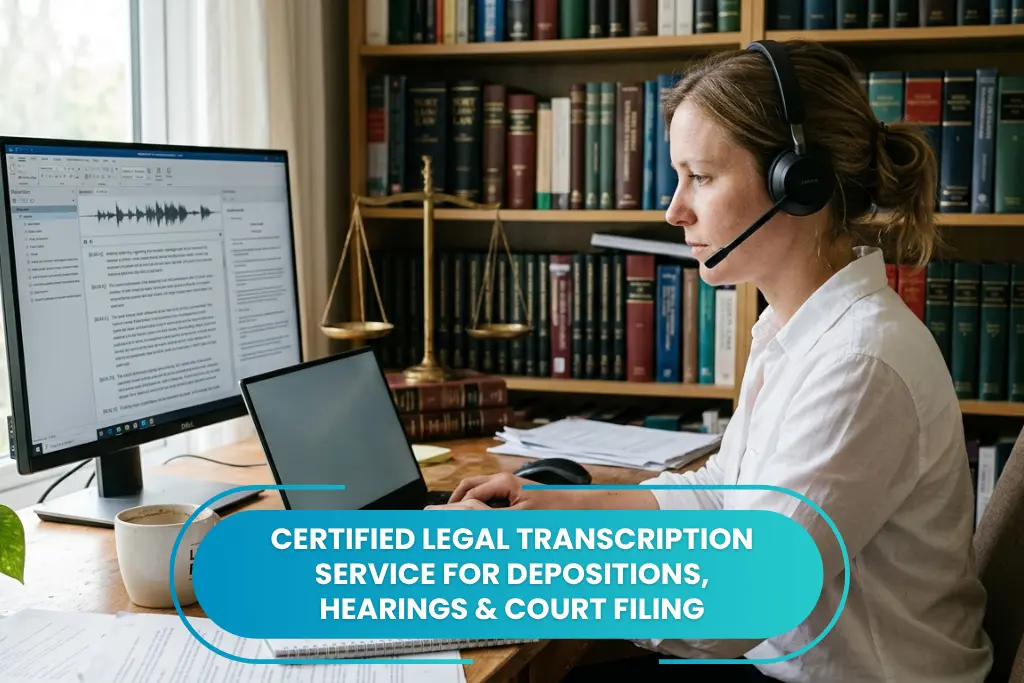
Certified legal transcription services convert spoken words from depositions, court hearings, witness testimony, and other legal proceedings into accurate, court-admissible written transcripts. Law firms, attorneys, and court reporting firms rely on these services to produce official records that meet the procedural standards of the legal system — transcripts that can be submitted as evidence, referenced during trial preparation, or filed directly with the court. Whether you need transcription of audio and video recordings from a deposition, a verbatim account of a recorded hearing, or conversion of legal audio from arbitrations and conference calls into written form, professional legal transcription service delivers the precision and confidentiality that the legal industry demands.
Why Law Firms and Legal Professionals Cannot Afford Errors in Legal Transcription
In the legal field, a single missed phrase or incorrectly transcribed term can alter the meaning of witness testimony, compromise evidence, or weaken a case built over months. This is precisely why legal transcription is a specialized discipline — it is not general transcription dressed in a suit.
Legal documents must reflect the exact spoken record. Court proceedings follow strict procedural timelines, and legal professionals need transcripts that are ready for immediate use in court filing, case reviews, and discovery processes. Inaccuracies in legal transcripts can lead to appeals, delays, or worse — miscarriages of justice. For attorneys managing multiple cases, and for court reporting firms handling high volumes of audio and video recordings, the stakes could not be higher.
Legal transcriptionists working on depositions and hearings must demonstrate command over legal terminology — from Latin maxims embedded in judicial opinion to jurisdiction-specific procedural language. This level of subject-matter fluency cannot be replicated through automation alone. The spoken nuances, overlapping speakers, and heavy accents common in court recordings require trained human judgment at every step of the transcription process.
What Sets Professional Legal Transcription Solutions Apart from Standard Services
Professional legal transcription solutions go well beyond converting audio files to text. Here is what distinguishes a qualified provider:
Verbatim Accuracy: Every “um,” stammer, or interruption that may be procedurally significant is preserved. Legal transcriptionists work to maintain the integrity of the spoken record without editorial interpretation.
Legal Terminology Proficiency: Transcribers assigned to legal transcription work are trained specifically in court and legal vocabulary — ensuring deposition transcripts, police reports, medical records entered as evidence, and hearing records are rendered with the correct legal language.
Confidentiality Protocols: Legal transcription service handles highly sensitive client information. Reputable providers enforce strict non-disclosure agreements, secure file transfer systems, and restricted team access — making confidentiality a top priority, not an afterthought.
Multi-Format Audio and Video Support: Modern legal proceedings generate diverse source material. Whether it is courtroom audio recordings, video transcription of recorded depositions, or electronic reporters’ logs, professional providers handle varied audio quality and source types without compromising output accuracy.
Faster Turnaround Times: Court deadlines and filing schedules are non-negotiable. Leading legal transcription service offers faster turnaround times — including rush delivery options — without cutting corners on accuracy.
Human Transcription: The Gold Standard for the Legal Industry
While court systems have experimented with voice recognition tools in administrative contexts, most legal transcriptionists and court reporters agree: human transcription remains the gold standard for legal proceedings where accuracy is paramount.
Legal audio often features suboptimal recording conditions — background noise, overlapping speakers, soft-spoken witnesses, or heavy regional accents. Automated tools struggle significantly with these variables. Legal transcriptionists bring contextual comprehension, familiarity with transcription techniques, and the ability to flag inaudible or unclear sections for attorney review — something no automated process handles with the reliability that the legal profession requires.
Human transcription also ensures that the transcript aligns with established legal format conventions — speaker identification, timestamps, exhibit references, and question-and-answer structure — all elements that court reporters and legal professionals rely upon for usability and compliance.
Audio and Video Legal Transcription Service for Court Reporting Firms and Beyond
The scope of legal transcription extends far beyond the courtroom. Court reporting firms, insurance companies, government agencies, and corporate legal departments all generate audio and video content requiring transcription into precise legal documents.
Video transcription services are in particularly high demand as depositions are increasingly conducted via video conference. Legal transcriptionists working with video recordings must synchronize transcript content with visual cues and speaker identification, producing records that can function as a standalone official record even without the video.
Legal audio from arbitrations, mediation sessions, disciplinary hearings, and regulatory proceedings also requires the same level of care as formal court reporting. Independent contractors and in-house transcription teams working within larger legal transcription solutions providers must apply consistent transcription techniques across all these source types.
Lingual Consultancy’s Certified Legal Transcription Service
Lingual Consultancy brings years of language services expertise to the legal transcription space. With a global network of more than 16,000 linguists and subject-matter specialists — including certified legal transcriptionists — Lingual Consultancy delivers legal transcription service to law firms, court reporting firms, and legal professionals across the United States, Europe, and Asia.
Lingual Cosultancy’s team ensures accuracy through a multi-stage quality assurance process, with every transcript reviewed by experienced legal transcriptionists before delivery. Confidentiality is a top priority: all projects are handled under strict non-disclosure agreements with secure file transfer systems protecting client data at every stage. Faster turnaround times are standard — including expedited delivery for urgent court filing. Lingual Consultancy supports audio and video transcription across all major formats, serving clients in over 250 languages for multilingual legal proceedings.
Choosing the Right Legal Transcription Partner
The legal industry does not offer a margin for error. When selecting a legal transcription service provider, law firms and legal professionals should prioritize certified expertise, demonstrable accuracy standards, proven confidentiality protocols, and the ability to deliver faster turnaround times without sacrificing quality.
Lingual Consultancy combines all of these qualities with over a decade of experience serving legal clients globally. From depositions and court hearings to complex multilingual arbitrations, Lingual Consultancy’s certified legal transcription services are built to meet the demands of the modern legal profession — accurately, securely, and on time.
Ready to get started? Contact Lingual Consultancy to discuss your legal transcription requirements and receive a tailored quote.
Frequently Asked Questions (FAQs)
1. What is the difference between court reporters and legal transcriptionists?
Court reporters are present in real time during court proceedings, capturing spoken words through stenography or voice writing as they happen. Legal transcriptionists, on the other hand, work from audio and video recordings — converting existing recorded content into written transcripts after the session has concluded. Both serve the legal system, but their functions are distinct: court reporters produce the live official record, while legal transcriptionists convert stored recordings into usable legal documents for review, filing, or evidentiary purposes.
Lingual Consultancy specializes in the transcription side — working from audio files, video recordings, and digital logs to produce formatted legal transcripts that meet court and client requirements.
2. How do legal transcription services ensure accuracy in complex hearings?
Accuracy in legal transcription comes from a combination of specialized training, deep legal terminology knowledge, and a structured review process. Legal transcriptionists assigned to depositions and hearings must be able to distinguish between similar-sounding legal terms, identify multiple speakers accurately, and flag sections where audio quality is insufficient for confident transcription.
At Lingual Consultancy, every legal transcription project goes through a two-stage review by trained legal transcriptionists before delivery. Our team works with a variety of audio quality levels and formats, applying consistent transcription techniques to ensure accuracy is never compromised by recording conditions.
3. What types of legal proceedings can be transcribed?
Legal transcription services cover a broad range of proceedings: depositions, court hearings, arbitrations, mediations, regulatory hearings, legislative sessions, police reports, witness testimony interviews, conference calls between legal teams, and internal compliance meetings. Both audio recordings and video recordings can be transcribed.
Lingual Consultancy handles transcription across all of these formats, including multilingual legal proceedings where the transcription must be paired with translation — a service area where Lingual Consultancy’s broader language expertise adds significant value to law firms operating internationally.
4. Is human transcription necessary, or can automated tools handle legal content?
Automated transcription tools can handle clean, well-recorded audio in controlled environments with reasonable results. However, legal audio frequently involves suboptimal conditions — variable recording quality, overlapping speakers, technical legal terminology, regional accents, and emotionally charged testimony. In these scenarios, automated tools produce error rates that are unacceptable for legal documents intended as an official record or submitted as evidence.
Most legal transcriptionists and legal professionals agree that human transcription is essential when accuracy, confidentiality, and legal formatting compliance are non-negotiable. Lingual Consultancy’s legal transcription services are delivered entirely through human transcriptionists — ensuring that every transcript meets the standards of the legal profession.
5. How is client confidentiality protected in legal transcription?
Legal transcription involves highly sensitive material: witness testimony, attorney-client communications, financial records, and personal information. Reputable legal transcription providers implement strict confidentiality protocols — including NDAs for all transcriptionists, encrypted file transfer systems, restricted access controls, and secure storage for all audio files and completed transcripts.
Confidentiality is a top priority at Lingual Consultancy. Every member of our legal transcription team works under a binding non-disclosure agreement, and all files are transferred and stored through secure, encrypted channels. Our ISO-certified processes extend to data handling — giving law firms and court reporting firms full confidence that sensitive client information is protected throughout the transcription process.
6. What turnaround times can law firms expect for legal transcription services?
Standard turnaround times for legal transcription typically range from 24 to 72 hours depending on audio length, complexity, and audio quality. For urgent court filing or deposition prep, many transcription services offer expedited options that deliver within a few hours.
Lingual Consultancy offers faster turnaround times as a core part of its legal transcription solutions — including priority processing for time-sensitive matters. Our project management team is available around the clock to coordinate urgent requests, ensuring that court deadlines and filing schedules are never missed.
7. Can legal transcription services handle multilingual depositions and hearings?
Yes, and this is a growing need as courts and law firms increasingly deal with parties, witnesses, and evidence across multiple languages. Multilingual legal proceedings require not just transcription but also translation — often simultaneously — and this requires providers with genuine expertise in both disciplines.
Lingual Consultancy is uniquely positioned here. As a full-service language solutions provider with certified translators and legal transcriptionists across 250+ languages, Lingual Consultancy can manage both transcription and translation for multilingual depositions, international arbitrations, and cross-border legal proceedings — streamlining the process for law firms and reducing the complexity of working with multiple vendors.

