
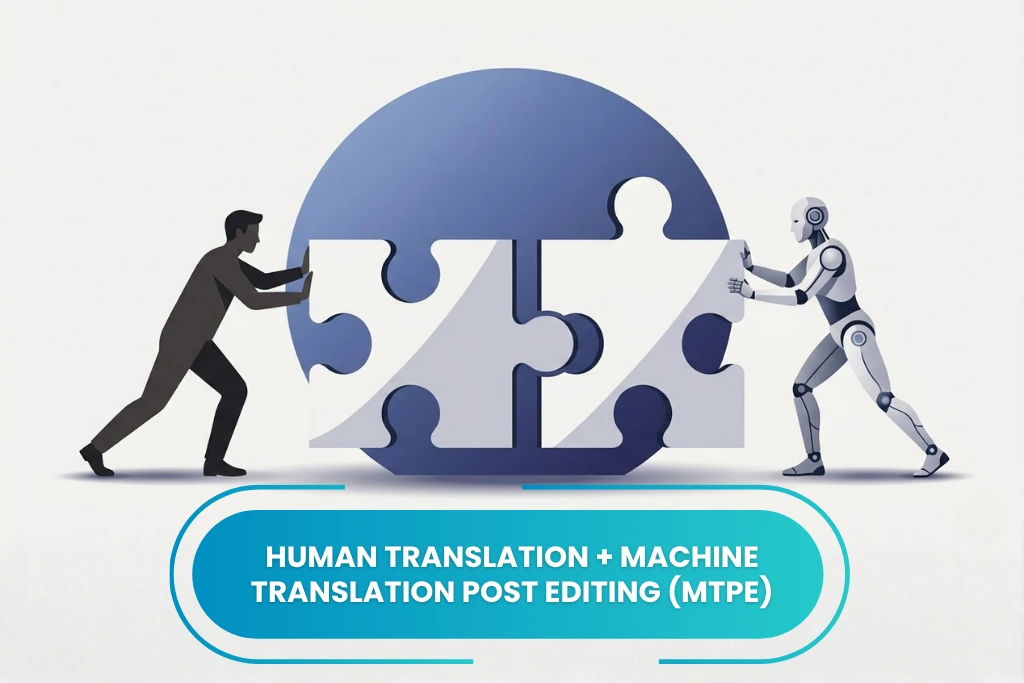
Scaling high-volume translation in 2026 means balancing speed, cost, and quality across multiple languages — and the most effective approach combines the power of neural machine translation with the precision of professional human translators. This blog explains how businesses facing large translation workloads can use machine translation post editing (MTPE) — including both light post editing and full post editing — alongside traditional human translation to achieve consistent quality without inflating budgets. Whether you are managing legal documents, marketing materials, or user-generated content, the right blend of AI translation and human expertise ensures that cultural nuances are respected, inconsistent terminology is eliminated, and every language pair meets the standards your audience expects.
Why High-Volume Human Translation Alone Is No Longer Sufficient
Demand for translated content has grown exponentially. Global e-commerce, multilingual product documentation, and cross-border regulatory filings mean organisations now need translations across dozens of language pairs simultaneously — often under tight deadlines. Traditional human translation, while unmatched in nuance, can become a bottleneck when volumes spike. A single human translator working at a standard pace of 2,000 words per day simply cannot keep up with the output a modern enterprise requires.
This does not mean human translators are being replaced. Quite the opposite. It means their expertise is being directed where it matters most: reviewing, refining, and adding the cultural intelligence that no machine can replicate. Human review remains the cornerstone of any high-quality translation workflow — it is what separates grammatically correct output from content that truly resonates.
How the Machine Translation Engine Changed the Economics
A modern machine translation engine — particularly one powered by neural machine translation (NMT) — can process millions of words in minutes. These MT systems have improved dramatically in recent years, producing machine translation output that is often fluent at the sentence level. However, raw machine translation output still struggles with complex sentence structures, industry-specific vocabulary, and the subtle shifts in meaning that define high-stakes content such as legal documents or brand voice communications.
The key insight is this: machine generated translation is a starting point, not a finished product. When fed into a robust post editing process with trained human editors, the overall translation efficiency rises significantly — costs drop, turnaround times shrink, and quality can be maintained or even improved compared to rushed manual editing.
Translation memory also plays a crucial role here. By storing approved translations and recycling consistent segments across projects, MT systems reduce post editing effort on repeat content, maintain consistency for key terms, and help human translators avoid spending time on material they have already perfected.
Machine Translation Post Editing: Light Post Editing vs. Full Post Editing
Not all content requires the same level of intervention. The machine translation post editing (MTPE) framework recognises this with two main tiers, and choosing the right one is essential for both quality and post editing efficiency.
Light Post Editing (LPE)
Light post editing focuses on making the machine translated output functionally accurate and grammatically correct. The post editor corrects grammatical errors, fixes spelling mistakes, and removes obvious translation errors, without necessarily achieving the natural flow of a human-written text. Light post editing focuses on acceptable quality for internal communications, user-generated content, and informational materials where a perfectly polished style is secondary to speed and cost. The human post editor works through the machine translated text efficiently, avoiding over editing that would negate the time savings.
Full Post Editing (FPE)
Full post editing aims to produce a final text that is indistinguishable from a professionally written human translation. The post editor addresses not just spelling mistakes and grammatical errors but also ensures the target language text has a natural flow, respects brand voice, handles cultural nuances correctly, and aligns with the style guidelines of the target market. Full post editing is the standard for marketing materials, legal documents, financial reports, and any content destined for a public or regulated audience.
The post editing process in both tiers is supported by quality estimation tools that flag high-risk segments in the machine output — allowing human translators to focus their effort on the sentences most likely to contain subtle errors, rather than reviewing every line with equal attention. This process optimisation dramatically reduces overall post editing effort while protecting translation quality.
Cultural Nuances and Inconsistent Terminology: The Human Advantage
Even the best machine translation engine struggles with two persistent challenges: cultural nuances and inconsistent terminology. A machine translated output may be technically accurate while still feeling tone-deaf — a serious risk for marketing materials or any content that aims to build trust with a local audience. Idiomatic expressions, humour, and culturally specific references rarely survive raw machine translation intact.
Inconsistent terminology is equally damaging in technical and regulated industries. When a product name, regulatory term, or legal phrase is translated differently across different sections of a document — or across projects — it undermines credibility and can create compliance risks. Human translators using carefully maintained glossaries and translation memories ensure that key terms are translated consistently throughout the entire process, across every language pair and every project.
This is where the pre editing stage also adds value. Before content enters the machine translation engine, a skilled linguist can restructure complex sentence structures, simplify ambiguous phrasing, and flag culturally sensitive passages — effectively improving the initial output quality before any post editing begins, which further reduces post editing effort downstream.
Maintaining Consistent Quality Across Language Pairs at Scale
One of the hardest challenges in high-volume translation is maintaining consistent quality across multiple languages simultaneously. Different language pairs have vastly different machine translation maturity levels — a machine translation engine may perform exceptionally well for English to French but produce far less reliable output for English to Thai or English to Arabic. A one-size-fits-all MTPE workflow will produce uneven results.
The solution is a tiered, language-pair-aware strategy. For high-resource language pairs with mature MT systems and large training datasets, light post editing may be sufficient for many content types. For lower-resource pairs, or for content with high cultural sensitivity, full post editing with expert human translators remains the right choice. Quality trends should be monitored across language pairs to continuously calibrate the balance between machine output and human effort.
Building the Right AI Translation + Human Hybrid Workflow
The most effective translation operations in 2026 are neither purely manual nor purely automated. They are hybrid systems designed around the nature of the content, the target language, the intended audience, and the available budget. Here is what a well-structured hybrid workflow typically includes: quality estimation at the segment level to prioritise human effort; translation memory integration to reduce post editing effort on repeated content; a clear distinction between content suitable for light post editing and content requiring full post editing; and regular calibration against approved translations to maintain brand voice and correct errors before they propagate across projects.
Human translators remain essential tools in this workflow — not as a fallback, but as the intelligence layer that ensures machine translated content is always fit for purpose. The goal is not to minimise human involvement but to maximise its impact by directing human expertise at the decisions and judgements that only a skilled, culturally fluent professional can make.
Frequently Asked Questions (FAQs)
1. What is the difference between light post editing and full post editing in MTPE?
Light post editing corrects the most obvious errors in machine translated output — spelling mistakes, grammatical errors, and factual inaccuracies — to reach an acceptable quality level suitable for internal use or informational content. Full post editing goes further, refining the text for natural flow, cultural nuances, brand voice, and stylistic consistency until the translated content reads as well as a professionally written human translation.
At Lingual Consultancy, both tiers are available as part of our MTPE service. Our expert linguists assess each project and recommend the appropriate level of post editing based on content type, target language, and end-use — so you never pay for more than you need, and never receive less quality than your content demands.
2. When should I choose human translation over machine translation post editing?
Human translation is the better choice for content where cultural nuances, brand tone, and precision are paramount — including legal documents, certified translations, sworn translations, creative marketing materials, and highly regulated medical or financial content. Where machine generated translation may introduce subtle errors that human review could miss under time pressure, a fully human workflow with dual-round proofreading offers stronger quality assurance.
Lingual Consultancy offers both traditional human translation and MTPE services, and our project managers will recommend the right approach based on your specific content and industry. For clients unsure which route to take, we offer quality estimation and a sample review before committing to a full project workflow.
3. How does machine translation handle inconsistent terminology across large projects?
Raw machine translation output is prone to inconsistent terminology — the same product name or technical term can be rendered differently across segments. Translation memory and project-specific glossaries, maintained by human translators, address this directly by enforcing consistent translation of key terms across the entire project and across language pairs.
Lingual Consultancy builds and maintains dedicated translation memories and term bases for clients with ongoing high-volume needs. This ensures that industry-specific vocabulary, brand terminology, and regulatory phrases are always translated consistently — reducing post editing effort on future projects and protecting the integrity of your content.
4. Can a machine translation engine handle all language pairs equally well?
No — machine translation systems perform significantly better for high-resource language pairs like English-French or English-German than for lower-resource pairs. The quality of the initial output varies, which means the level of post editing required also varies. For some language pairs, full post editing is always necessary to correct errors and ensure the translated content meets publication standards.
With coverage across 250+ languages and a global network of 16,000+ professional translators, Lingual Consultancy calibrates its MTPE workflows on a language-pair-by-language-pair basis. This ensures that the quality of the final translated output is consistent regardless of whether you are translating into widely supported European languages or into less-resourced Asian or African languages.
5. What types of content are best suited for machine translation post editing?
MTPE works best for high-volume, repetitive, or time-sensitive content where full human translation would be too slow or expensive: product descriptions, software UI strings, technical manuals, e-learning modules, and user-generated content are all strong candidates. For content with stable, predictable structure and relatively straightforward language, machine translation output combined with light post editing can deliver publication-ready results efficiently.
Lingual Consultancy’s MTPE service covers a wide range of content types across industries including IT, life sciences, e-commerce, and market research. Our linguists are trained to identify which segments in a document require deeper human review and which can be approved quickly — keeping the overall post editing process efficient without compromising on translation quality.
6. How do you ensure consistent quality when scaling to multiple languages simultaneously?
Consistent quality at scale requires a combination of translation memory, well-maintained glossaries, quality estimation tools, and skilled post editors who understand both the source and target language deeply. Monitoring quality trends across language pairs and running periodic quality audits helps catch inconsistent terminology and systematic translation errors before they reach the final audience.
Lingual Consultancy’s ISO-certified quality assurance processes include dual-round proofreading, dedicated project management, and terminology management for clients with multi-language programmes. Whether you are scaling across five languages or fifty, our processes are designed to maintain the same standard of consistent quality across every language pair in your project.
7. Is MTPE a good option for marketing materials and brand content?
Marketing materials require particular care because they depend on brand voice, cultural resonance, and persuasive language — areas where machine translation post editing carries real risk if the post editing process is not thorough. For these content types, full post editing by a human editor with marketing copywriting experience is strongly recommended. Light post editing is generally not sufficient for externally published brand content.
At Lingual Consultancy, our marketing translation and transcreation services blend MTPE with experienced marketing linguists who understand how to adapt brand voice across cultures. For clients with high-frequency marketing content across multiple languages, we combine translation memory and terminology management with full post editing to deliver translated content that sounds as compelling in the target language as it does in the original.

