
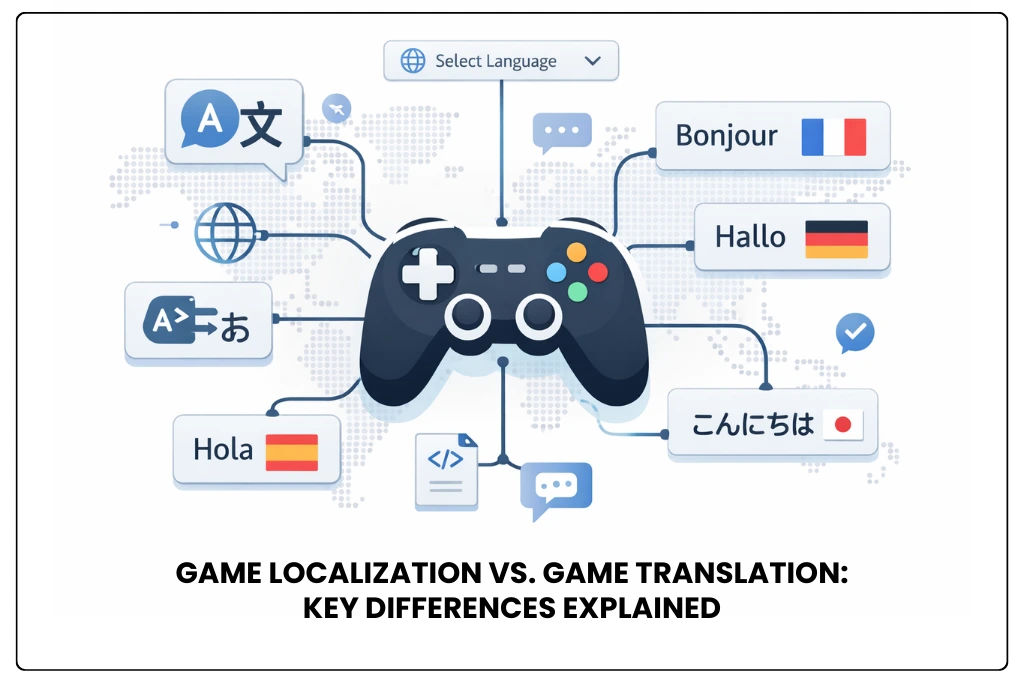
Game localization and game translation are not the same thing — and confusing the two can cost game developers their foothold in new markets. Game translation converts text from a source language into a target language, while game localization is a far broader process that adapts every element of a game — dialogue, user interface, art assets, cultural references, and even audio — so that players in a target culture feel the game was built specifically for them. This guide breaks down the key differences, explains why each matters in the global video game industry, and shows what a complete localization process looks like in 2026.
What Is Game Translation?
At its core, game translation means converting on-screen text, dialogue strings, and in-game instructions from one language into another. A translator working on a video game might handle menus, item descriptions, cut scenes, subtitles, and tutorial prompts. The goal is linguistic accuracy — the translated text should faithfully reflect the meaning of the source language.
Game translation is the entry point for many studios trying to reach multiple languages quickly. It is faster and less expensive than full localization, and for certain game types — puzzle games with minimal narrative, for example — it may be entirely sufficient. That said, translation studies consistently show that word-for-word rendering often falls short in games, where tone, humor, and context matter enormously to the player’s immersion.
Poor translation is one of the fastest ways to break a gaming experience. When dialogue sounds unnatural or on-screen text fails to fit within the UI, players notice immediately.
What Is Game Localization?
Game localization goes significantly further than translating video games. It is the complete adaptation of a game for a specific target market — encompassing language, culture, visuals, audio, and functionality. The localization process typically includes:
Translation of all in-game text and dialogue strings
Audio localization and voice-over recording with native translators
Cultural adaptation of art assets, symbols, and marketing materials
Adjustment of the user interface to accommodate different languages
Rigorous testing of the localized version across different devices and regions
A well-localized game feels native to its audience. The Japanese version of a game set in feudal Japan should feel entirely different from the same game’s German localization — not just in language but in cultural tone and design. This is what separates localization from simple translation.
Key Differences: Game Translation vs. Game Localization
The clearest way to understand the distinction is scope. Game translation handles text. Game localization handles the entire game world as experienced by a local audience.
Consider the classic example of Pac-Man. The original Japanese name was Puck Man, but when it was brought to Western markets, localization teams changed the name to avoid an obvious and unwanted modification of the character on arcade cabinets. That decision went far beyond translation — it was a cultural and marketing call made by people who understood the target market. It is a small but instructive example of the kind of cultural changes that localization demands.
Another key difference is the involvement of the development team. Translation can often happen post-launch with minimal engineering support. Full localization, however, requires close collaboration with developers from the earliest stages. Internationalization — the process of building a game’s code to support multiple languages and character sets — must happen before any localized version can be produced cleanly. A localization kit prepared early in game development saves enormous time and expense later.
Finally, language services for localization must account for sensitive content. What is acceptable in one region may be restricted or outright banned in another. South Korea, Germany, and several other markets have specific regulations around violence, political symbolism, and depictions of gambling that require careful review during the localization process.
How Native Translators and Cultural Adaptation Shape Game Content
One of the most important factors in successful video game localization is who does the work. Native translators — linguists who are fluent in the target language and deeply familiar with the target culture — catch the nuances that bilingual generalists often miss. Idioms, regional humor, cultural references to history or pop culture, and the register appropriate for a given genre all require a deep understanding that goes beyond dictionary fluency.
Cultural adaptation extends to art assets as well. Images, icons, and symbols that carry no particular meaning in one culture may be deeply offensive or confusing in another. A game released simultaneously across global markets — a practice known as sim ship, or simultaneous shipment — must have these issues resolved before launch, not after.
The localized version of a game is not a translation of the original. It is a culturally authentic experience designed for a specific audience. That distinction drives every decision made during the localization process.
Continuous Localization, Smart MT, and Language Services at Global Scale
Modern games are not static products. Post-gold updates, downloadable content, seasonal events, and game updates can add thousands of new words of game content within days of a major release. Managing this at global scale requires a continuous localization workflow — a system where new content is flagged, translated, reviewed, and published as part of an ongoing cycle rather than a one-time project.
This is where smart MT (machine translation with human post-editing) plays a valuable supporting role. Smart MT can dramatically accelerate the translation of repetitive or structured content — item descriptions, patch notes, UI strings — while human experts handle narrative dialogue, marketing materials, and anything requiring genuine cultural judgment. The combination keeps quality control intact without sacrificing speed.
A well-maintained style guide is essential to this process. It documents the tone, terminology, and formatting conventions for each target language, ensuring that translators working across different regions produce a consistent gaming experience. Without a style guide, even excellent individual translators can produce localized versions that feel disjointed or off-brand.
The Bottom Line
The global video game industry is worth hundreds of billions of dollars, and the majority of players are not native English speakers. Game developers who treat translation and localization as afterthoughts leave a significant share of that market untouched. Understanding the difference between game translation and game localization — and knowing when each is appropriate — is the first step toward building a genuinely global game.
Whether you need precise translations for a lean indie release or a full localization pipeline for a AAA title launching across new markets simultaneously, Lingual Consultancy has the team, the tools, and the cultural expertise to support every stage of the process. With 16,000+ linguists across the globe, in-house smart MT technology, and dedicated game localization specialists, the team is built for exactly this kind of work.
Reach out to Lingual Consultancy to discuss your next game’s language services needs — and take the first step toward making your game truly global.
Frequently Asked Questions (FAQs)
1. What is the difference between game translation and game localization?
Game translation converts text — dialogue, menus, subtitles — from one language into another. Game localization is broader: it adapts the entire game experience, including audio, art assets, cultural references, and UI, so it feels native to the target market. Translation is a part of localization, not a substitute for it.
Not sure which your project needs? Lingual Consultancy can assess your game’s scope and recommend the right level of language services, from targeted translation to full localization across multiple languages.
2. Why do game developers need native translators instead of just machine translation?
Machine translation can’t reliably handle idioms, humor, cultural references, or genre-appropriate tone. For narrative or dialogue-heavy games, poor translation breaks player immersion fast. Native translators bring the cultural context and gaming familiarity that machines simply lack.
At Lingual Consultancy, projects are handled by native translators — many of them gamers — ensuring the localized version reads and feels as intended for each target audience.
3. What does a localization kit include, and why does it matter?
A localization kit packages everything translators need: dialogue strings, UI copy, a terminology glossary, a style guide, and contextual notes on how content appears in-game. A good kit reduces errors and keeps quality consistent across languages.
Lingual Consultancy helps development teams build localization kits early in the process — saving significant time and cost down the line, especially for studios managing multiple languages simultaneously.
4. What is continuous localization, and when does a game need it?
Continuous localization keeps translation running in parallel with ongoing game updates rather than treating it as a one-off project. Any live-service game releasing regular content — new characters, events, patches — needs this to avoid a fragmented experience for international players.
Lingual Consultancy supports continuous localization workflows for live titles, combining smart MT for high-volume content with human review for anything narrative or culturally nuanced.
5. How does cultural adaptation affect game content beyond language?
Symbols, gestures, colors, and depictions of violence or religion can carry very different meanings across cultures. Art assets and cut scenes that work in one market may need to be adjusted for another — especially for regulated markets like South Korea or Germany.
Lingual Consultancy’s teams include cultural consultants who review game content for these issues before launch, helping studios enter new markets without costly post-release corrections.
6. Is it worth localizing a game if the target audience speaks English?
Yes. Even in high-English-proficiency markets, players consistently prefer their native language. Localized games outperform English-only releases on downloads, ratings, and retention. Language localization is one of the better-returning investments a studio can make before entering international markets.
Lingual Consultancy works with studios of all sizes to identify where localization investment makes the most sense, whether that’s a focused translation or full cultural adaptation across new regions.
7. What quality control steps are involved in video game localization?
QA in game localization goes beyond proofreading. A second linguist reviews translated strings in-game to check for tone, UI fit, and accuracy. This is followed by functional testing for text overflow, encoding issues, and platform-specific bugs. Audio localization requires additional timing and lip-sync review.
Lingual Consultancy runs rigorous testing at every stage with dedicated game QA testers, so the localized version holds up to the same standard as the original release.

