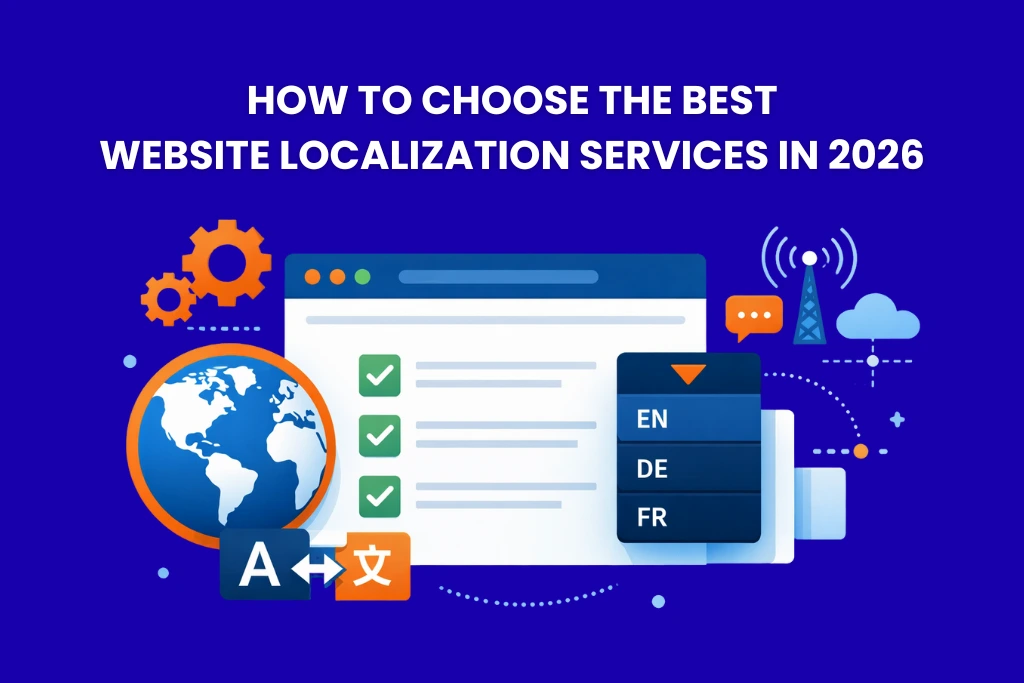
Expanding your website to new markets is more than translating words — it’s about making each web page feel like it was made for your target audience. The right website localization partner helps you adapt language, design, and user experience so visitors in Spanish-, French-, Chinese-, Japanese- or any other language-speaking markets can easily understand, trust, and use your site. This guide explains how to choose the best website localization services in 2026, with clear steps and practical questions to ask.
What Website Localization Really Means
Website localization goes beyond literal website translation. It’s the full translation process plus cultural adaptation: choosing the right words for a preferred language, aligning tone and imagery with local culture, adjusting dates, currencies, and number formats, and ensuring the page displays correctly in different browsers and devices. Effective website localization removes language barriers and helps users navigate your web content as if it were written in their own market.
Start by Defining Your Goals and Scope
Start by being specific about what you need. Are you translating product pages to increase sales, localizing help-center content to reduce support tickets, or adapting a marketing campaign for brand awareness? Decide:
- Which target languages and countries matter most (Spanish, French, Chinese, Japanese, etc.).
- Whether you need a one-time website translation or ongoing localization support.
- The types of files you’ll submit (web pages, PDFs, videos, images).
- Your priorities: fast turnaround, strict accuracy, or cultural nuance.
Clear goals help translation services propose the right workflow and pricing model for your project.
Choose Native Speakers and Trusted Experts
Look for providers that use native human translators and expert linguists for each language pair. Native linguists deliver accurate translations that preserve tone and avoid awkward phrasing or typos. For technical, legal, or government content, ask whether the provider offers certified translations or specialist reviewers with domain experience. Expert linguists and subject-matter reviewers are vital when accuracy and compliance matter.
Look for More Than Just Translation
Top website localization services treat localization as a holistic project. Ask if they offer:
- UI and UX localization so menus, buttons, and page layouts still make sense in the translated page.
- Desktop and mobile testing so long translated text doesn’t break designs.
- Localization of multimedia (videos, subtitles, image text, downloadable PDFs).
- Support for various web technologies and CMS integrations to automate the translation process.
A partner that handles technical adaptation and content strategy will help your site function well for real users, not just display translated text.
Check Their Experience With Your Website Type
Different website types present different challenges. Ask for examples or case studies showing work on:
- eCommerce sites — product descriptions, carts, and checkout flows.
- Content sites and media — article pages, video subtitles, and heavy publishing workflows.
- Corporate websites — legal pages, resources, and downloadable documents.
- SaaS platforms — in-app strings, help docs, and dynamic content.
Experience with a similar web page or business model reduces rework and speeds up the translation process.
Don’t Overlook Quality Checks and Testing
Professional services include quality control steps that go beyond a single pass of translation. Verify they provide:
- Human proofreading and editing to catch errors and improve readability.
- Functional testing for links, forms, and embedded video after translation.
- Cross-browser and cross-device checks so the webpage renders properly everywhere.
- A client review process so your internal team can request changes before launch.
Quality assurance ensures your translated pages are accurate, polished, and ready for users.
Look for Scalable Workflows and Long-term Support
Your website will change. Choose a service that supports ongoing localization with clear workflows:
- A single platform or portal to submit links, files, and project requests.
- Version control and translation memory to reuse previously translated content and reduce costs.
- Defined SLAs for updates, with options for fast turnaround when needed.
- Dedicated project managers who act as a consistent point of contact.
Scalable processes let you translate websites regularly without redoing setup, so your global reach grows smoothly.
Understand Pricing, Timelines, and Transparency
Pricing can be per word, per page, or project-based. Ask for itemized quotes and examples:
- What’s included in the price (proofreading, QA, format fixes, CMS work)?
- How long does it take to translate a typical page or a full site?
- Are there rush fees for fast turnaround?
- Who will manage the workflow and how will you track progress?
Transparent pricing and timelines help you plan budgets and avoid surprises during the project.
Make Sure Security, Compliance, and Accessibility are Covered
If your website handles user data, legal documents, or government content, confirm the provider’s security and compliance practices:
- Data protection measures for files and CMS access.
- Compliance with local rules about content, privacy, or certified translations.
- Accessibility checks to ensure the translated webpage meets standards for users with disabilities.
Security and compliance are essential for protecting users and your company’s reputation.
Red Flags to Watch Out for When Choosing Website Translation Services
When evaluating providers, it’s important to recognize warning signs that can indicate poor quality or unreliable service. Be cautious of website translation services that show the following red flags:
- Over-reliance on automation: Providers that depend solely on automated tools without human review often deliver content with errors, unnatural language, and missed cultural context.
- Unrealistic turnaround promises: Instant delivery for complex websites, especially without testing or quality checks, can compromise accuracy and user experience.
- Lack of proven experience: An inability to share relevant case studies, client references, or industry-specific examples makes it difficult to assess credibility.
- Unclear communication or pricing: Vague workflows, limited communication channels, or undefined pricing structures can lead to delays, hidden costs, and inconsistent results.
Identifying these issues early can help you avoid costly mistakes and choose a website translation partner you can rely on.
Key Takeaways: Making the Right Choice
In 2026, the best website localization services combine human expertise with efficient technology to deliver website translation that truly connects with local users. Focus on providers that center native linguists, test translated pages in real browsers and devices, and offer a clear, ongoing process for updates. When you choose a partner that understands language and culture — and can also integrate with your web systems — your website becomes a genuine local experience that builds trust and drives results.
Frequently Asked Questions (FAQs)
Do website localization services use native translators and expert linguists?
Most professional website localization services rely on native translators and expert linguists to ensure accuracy, cultural relevance, and natural flow in the target language. This approach helps websites connect authentically with local audiences. At Lingual Consultancy, we take this a step further by carefully selecting linguists based on language expertise, subject matter knowledge, and audience needs.Lingual Consultancy ensures every translation is reviewed for tone, clarity, and cultural fit, so your website feels truly local.
Can website localization services handle UI, multimedia, and downloadable content?
Yes, modern localization services extend beyond text to include UI elements, multimedia, and downloadable assets like PDFs or videos. This ensures that every part of a website is accessible and engaging for users in different regions. Lingual Consultancy specializes in this holistic approach, guiding the adaptation of interfaces, visuals, and documents so that every asset communicates effectively in the target language and culture.
Do website localization services support CMS integration or centralized workflows?
Many advanced providers offer CMS integration and centralized workflows to simplify content management. This allows businesses to update and expand their websites without losing consistency across languages. Lingual Consultancy supports seamless CMS integration, applying defined language rules, terminology, and style guidelines across platforms. With Lingual Consultancy, every update maintains the same quality and consistency, no matter how large your website grows.
Is there a quality assurance process for website localization?
Quality assurance is a critical part of any localization process, involving proofreading, linguistic review, and functional testing to ensure accuracy and usability. Lingual Consultancy places strong emphasis on QA, overseeing every stage of review to guarantee that localized pages are error-free, culturally appropriate, and optimized for different browsers and devices.
Do website localization services support multiple language pairs?
Yes, most services are designed to handle multiple language pairs, enabling businesses to reach diverse global audiences. Lingual Consultancy offers extensive support across languages, from English–Spanish to English–Chinese and beyond. Each project follows strict quality benchmarks while respecting the unique cultural and linguistic nuances of every market.
Are timelines, pricing, and account management clearly defined?
Transparency is a hallmark of reliable localization services, with clear timelines, pricing models, and structured account management to avoid surprises. Lingual Consultancy ensures full clarity, setting realistic schedules, defining quality checkpoints, and offering straightforward pricing. With Lingual Consultancy, you can expect fast turnaround times without compromising accuracy or consistency.