
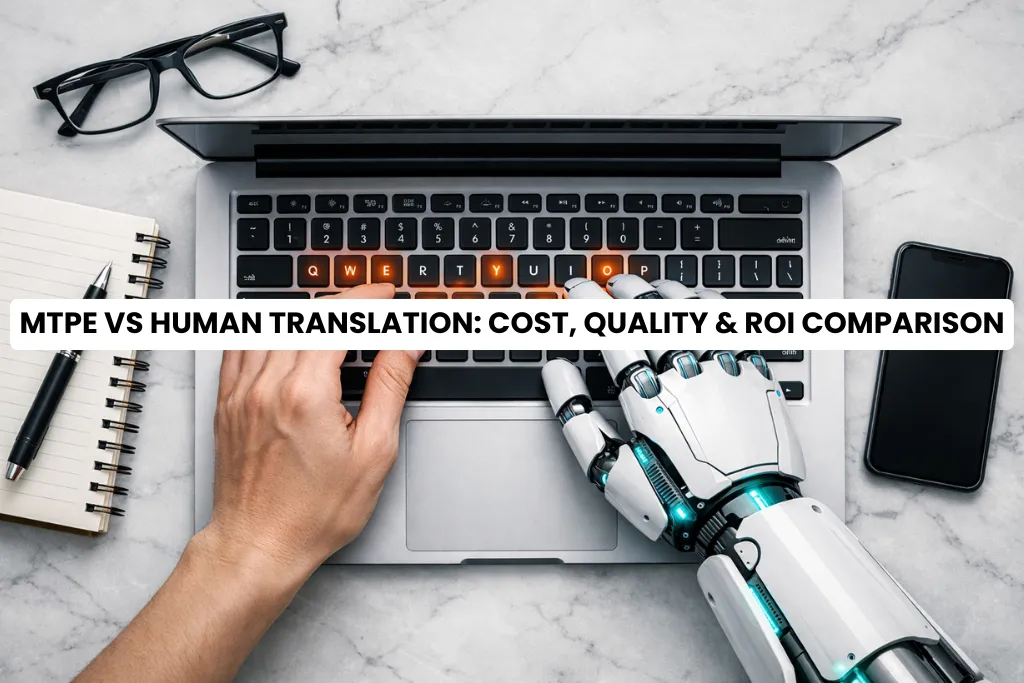
MTPE vs human translation is one of the most debated choices in the translation industry in 2026. This blog offers a structured, side-by-side comparison of Machine Translation Post Editing (machine translation post editing) and human translation, evaluating them on cost, quality, and return on investment (ROI). It explores how machine translation—powered by neural machine translation and generative AI—has progressed far beyond basic tools like Google Translate and Microsoft Translator into scalable, business-ready MT systems. At the same time, it explains why human translators remain indispensable for cultural nuance, brand consistency, and high-stakes content. Through real-world use cases, workflow insights, and a cost-benefit analysis, this page helps businesses determine when to use light or full post editing versus traditional human translation, and how Lingual Consultancy blends AI with human expertise for reliable, scalable, high-ROI multilingual communication.
Machine Translation Post Editing: How AI and Human Post Work Together in 2026
Machine translation post editing (MTPE) has become a core part of modern localization workflows. Unlike pure machine translation, where AI translates text without human involvement, MTPE combines machine generated translation with human post editing to refine meaning, grammar, tone, and context. In 2026, AI powered translation engines—especially neural machine translation (NMT)—produce far more natural output than earlier rule-based systems, yet they still struggle with idioms, cultural nuances, industry terminology, and brand voice.
When businesses paste text into tools like Google Translate, Microsoft Translator, or proprietary MT systems, the machine translated output may contain grammatical errors, spelling mistakes, or awkward phrasing in the target language. A post editor—usually a professional linguist—then reviews the translated output to improve accuracy, ensure consistency, and align the translation with style guides and terminology management rules. This hybrid process reduces turnaround time while maintaining high translation quality, making it one of the most cost-effective approaches in the translation industry today.
Machine Translation: Faster, Scalable, and Cost-Effective in 2026
Machine translation has transformed how organizations translate text across many languages. With artificial intelligence and generative AI tools advancing rapidly, AI translations are now faster, more context-aware, and better at handling multiple language pairs than ever before. Adaptive MT systems learn from translation memory databases, previous projects, and human feedback to gradually improve MT accuracy over time.
For businesses that need to translate large volumes of content—such as e-learning platforms, e-commerce websites, technical manuals, or customer support content—machine translation offers unmatched scalability and lower cost compared to traditional human translation. Instead of waiting days or weeks for a translator to process how many words manually, companies can instantly generate a post edited machine translation in seconds. This is particularly beneficial when the goal is to reach a global audience quickly and expand global reach across different languages.
However, pure machine translation still has limitations. While an AI translator can handle basic sentences well, it may misinterpret tone, context, or intent in the original text, especially when translating creative marketing copy, legal documents, or culturally sensitive content. This is where human translators and post editing become crucial.
Human Translation: Why Human Translators Still Matter More Than Ever
Despite advances in artificial intelligence, human translation remains indispensable for high-quality, professional localization. Human translators bring deep linguistic knowledge, cultural sensitivity, and industry expertise that no machine can fully replicate. A professional translator does more than convert words from a source language to a target language—they interpret meaning, intent, tone, and context.
For brands that care about maintaining a consistent brand voice, engaging professional translators ensures that the final translation sounds natural, culturally appropriate, and aligned with the company’s identity. Unlike machine generated translation, human translation accounts for cultural nuances, local expressions, and emotional impact, which are especially important in marketing, legal, and creative content.
Additionally, human expertise is critical when working with specialized fields such as healthcare, legal, finance, or technical documentation. Language professionals use terminology management tools, translation memory, and style guides to ensure consistency across projects and maintain high translation quality.
Machine Translation vs Human Translation: Cost Comparison in 2026
One of the biggest factors influencing translation decisions is cost. In 2026, businesses must balance budget, speed, and quality when choosing between machine translation, post editing machine translation, and human translation.
Machine Translation Cost
Machine translation alone is the most affordable option. Many tools, including Google Translate and Microsoft Translator, are free or low-cost, making them attractive for quick, internal translations or non-critical content. However, relying solely on machine translation can result in poor translation that requires additional editing later, potentially increasing costs.
MTPE (Machine Translation Post Editing) Cost
Machine translation post editing offers a middle-ground solution. By using AI powered translation first and then engaging a post editor to refine the output, businesses can significantly reduce translation costs while still achieving accurate translations. Light post editing is cheaper than full post editing and is suitable for content that doesn’t require a highly polished style.
Human Translation Cost
Traditional human translation is the most expensive option, as it requires skilled professional translators to translate every word manually. However, it delivers the highest level of quality, particularly for creative, legal, or highly sensitive content where even minor errors could have serious consequences.
Human Translation vs MTPE: Which Delivers Better Quality?
Quality depends on content type, target audience, and purpose. For factual, repetitive, or technical content, machine translation post editing often delivers excellent results at a fraction of the cost of full human translation. Thanks to neural machine translation and translation memory, MT systems can now produce highly accurate baseline translations that require minimal post editing.
However, for content that requires emotional tone, persuasive language, or cultural adaptation, human translation remains superior. Human translators excel at capturing meaning beyond literal word-for-word translation, ensuring that the translated output resonates with native speakers in other languages.
Lingual Consultancy adopts a smart, project-based approach—using machine translation post editing for large-scale, time-sensitive projects while reserving human translation for high-impact content that demands creative and cultural precision.
Post Editing Machine Translation: Light vs Full Post Editing
Not all post editing is the same. There are two main approaches:
Light Post Editing
Light post editing focuses on correcting obvious grammatical errors, spelling mistakes, and major meaning issues while preserving the overall structure of the machine translated output. This is ideal for internal documents, knowledge bases, or content that doesn’t require stylistic perfection.
Full Post Editing
Full post editing involves deeper review, including tone adjustment, brand voice alignment, terminology management, and cultural sensitivity. This approach makes the translated output nearly indistinguishable from human translation while still benefiting from the speed of machine translation.
Lingual Consultancy helps clients determine the right level of post editing based on their goals, budget, and target audience.
AI Translations, Human Expertise, and Brand Voice Consistency
A key challenge with AI translations is maintaining brand voice consistent across many languages. While AI powered translation is efficient, it may produce generic or unnatural phrasing that doesn’t reflect a company’s identity. This is why human involvement is essential.
A professional linguist acting as a post editor ensures that the final translation is grammatically correct, culturally appropriate, and aligned with brand guidelines. By combining machine translation with human expertise, businesses achieve both efficiency and authenticity.
The Role of Translation Memory and Adaptive MT in 2026
Translation memory (TM) plays a major role in improving efficiency and consistency in machine translation post editing workflows. TM stores previously translated segments so they can be reused in future projects, reducing repetition and ensuring consistency across documents.
Adaptive MT systems learn from past translations, continuously improving accuracy over time. This means that the more a company translates, the better its AI translator becomes—leading to higher mt accuracy and reduced post editing effort in the long run.
Ensuring Accuracy, Consistency, and Quality Assurance
Regardless of whether businesses use machine translation, post editing machine translation, or human translation, quality assurance is essential. Lingual Consultancy employs rigorous QA processes, including proofreading, editing, and final review by language professionals to ensure accuracy, clarity, and consistency.
This multi-layered approach helps eliminate grammatical errors, improve accuracy, and ensure that the translated output fully conveys the meaning of the original text.
Cost, Quality, and ROI: Which Approach Delivers the Best Value?
From an ROI perspective, machine translation post editing offers the best balance between speed, cost, and quality for most business use cases in 2026. It enables companies to translate content at scale, reach audiences in many languages, and reduce costs without sacrificing reliability.
However, for premium content where brand perception, legal accuracy, or cultural impact is critical, investing in human translation yields higher long-term value.
Lingual Consultancy helps businesses optimize their translation strategy by analyzing project requirements, target audience, and budget to recommend the most effective translation based approach.
When Should Businesses Choose MTPE vs Human Translation?
Choose MTPE when:
- You need to translate large volumes of content quickly
- Budget constraints are a priority
- Content is technical, repetitive, or informational
- You want lower cost with good translation quality
Choose Human Translation when:
- Content is creative, marketing-driven, or legally sensitive
- Cultural nuances are critical
- Brand voice consistency is a top priority
- You need highly polished, human-level language
How Lingual Consultancy Blends AI and Human Expertise
Lingual Consultancy takes a hybrid approach that leverages artificial intelligence, neural machine translation, and human translators to deliver high-quality multilingual communication solutions. By integrating adaptive MT, translation memory, and expert post editors, Lingual Consultancy ensures that every project meets client expectations for accuracy, consistency, and cultural relevance.
Whether you need to translate one language or expand into many languages, Lingual Consultancy provides customized workflows that balance speed, cost, and quality—helping businesses maximize their global reach with confidence.
Conclusion: The Smart Choice for 2026 and Beyond
The debate between machine translation post editing (MTPE) and human translation is not about choosing one over the other—it’s about using the right approach for the right content. In 2026, businesses that combine AI powered translation with human expertise will gain a competitive edge in global communication.
With its blend of advanced MT systems, skilled professional translators, and robust quality assurance processes, Lingual Consultancy stands as a trusted partner for organizations seeking accurate translations, efficient workflows, and strong ROI in the evolving translation industry.
Frequently Asked Questions (FAQs)
1. What is the main difference between MTPE and human translation?
The key difference is that machine translation post editing (MTPE) starts with machine translation—usually powered by neural machine translation or tools like Google Translate or Microsoft Translator—followed by human post editing, whereas human translation is carried out entirely by professional translators from the start. MTPE is faster and more cost-effective for large volumes of content, while human translation is better suited for creative, legal, or culturally sensitive material. Lingual Consultancy helps businesses decide between these approaches based on content type, target audience, and desired translation quality.
2. Is MTPE reliable for business translation?
Yes, MTPE is highly reliable when implemented correctly. Modern AI-powered translation systems generate much stronger machine translated output than in the past, and when this is refined through professional post editing, the final translated output is typically accurate, grammatically correct, and contextually appropriate. Lingual Consultancy combines adaptive MT, translation memory, and expert post editors to ensure accuracy, consistency, and quality assurance across projects.
3. Does MTPE really reduce translation costs?
MTPE significantly lowers costs compared to traditional human translation because the initial draft is created by machine translation, reducing the time required from human translators. Light post editing further lowers costs for internal or informational content, while full post editing is used when higher polish is required. Lingual Consultancy designs customized MTPE workflows that balance lower cost with high translation quality.
4. Can MTPE match the quality of human translation?
For technical, repetitive, or high-volume content, MTPE can come very close to human translation in quality—especially with neural machine translation and skilled post editors involved. However, for creative marketing copy or content that requires deep cultural sensitivity and brand voice alignment, human translation remains superior. Lingual Consultancy evaluates each project to recommend whether MTPE or full human translation is the best fit.
5. When should a business choose MTPE instead of human translation?
Businesses should choose MTPE when they need to translate large volumes of text quickly, are working with structured or technical content, or are operating under budget constraints. It is also ideal when consistency across many languages is a priority, as translation memory and terminology management tools help ensure consistency. Lingual Consultancy helps organizations determine the right approach based on their goals, timelines, and target audience.
6. How to ensure translation quality in MTPE projects?
Lingual Consultancy follows a multi-step process that includes machine translation, professional post editing, and rigorous quality assurance checks. Language professionals review for grammatical errors, spelling mistakes, cultural nuances, terminology accuracy, and brand voice consistency. This ensures that the final translation reflects the meaning of the original text while sounding natural in the target language.
7. Is MTPE suitable for all types of content?
No, MTPE is best suited for technical, informational, and large-scale content such as manuals, e-learning materials, websites, and support documentation. Highly creative, legal, or culturally nuanced content is better handled through human translation. Lingual Consultancy assesses each project individually and recommends either MTPE, human translation, or a hybrid approach to maximize ROI and translation quality.

